
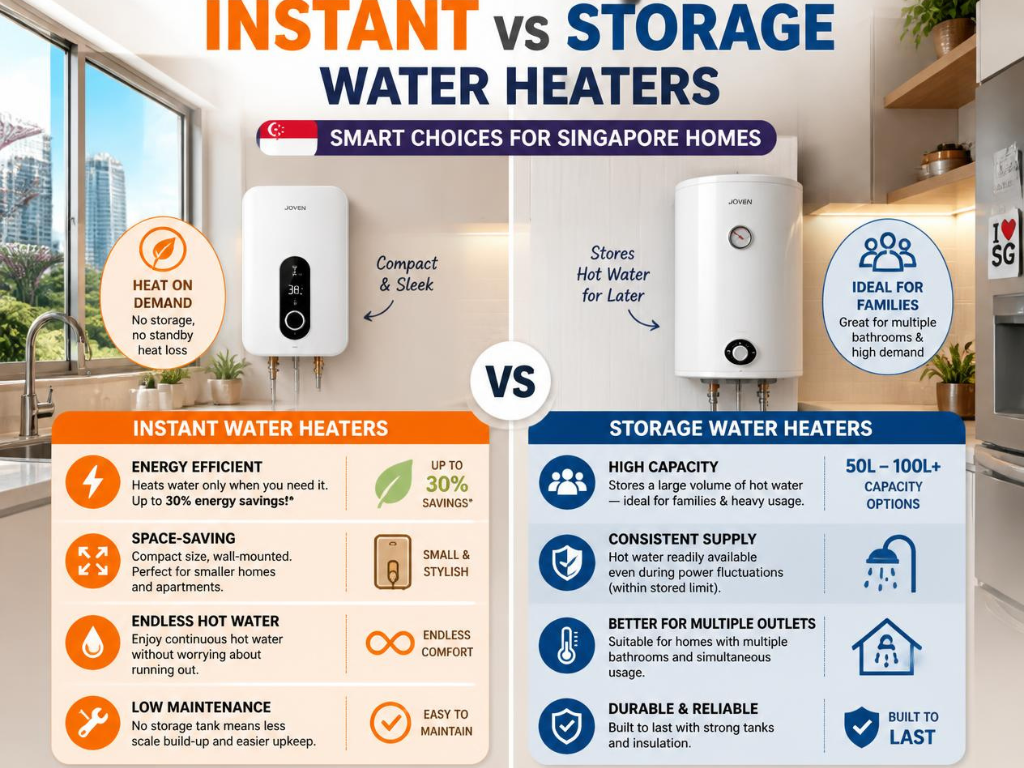

Choosing between an instant and a storage water heater in Singapore is an electrical decision more than a comfort one. Household electricity hit 34.78 cents per kWh including GST on 1 July 2026, the steepest quarterly jump on record. This blog walks you through kilowatt draw, running cost, tank sizing, and which one legally needs a licensed plumber for plumbing installation services.
What is the actual difference between an instant and a storage water heater?
An instant heater warms water on demand as it flows through a heating element, holding nothing in reserve. A storage heater warms a tank of water in advance and keeps it hot until you draw it.
That single design difference drives everything else. Instant units draw a large amount of power for the short period you are showering, typically 3.3kW to 8.8kW depending on model. Storage units draw less, commonly 1.5kW to 3kW, but they run intermittently around the clock to hold the tank at temperature.
Physical footprint follows the same logic. An instant heater is a wall box roughly the size of a hardback book, mounted beside the shower. A storage heater is a cylinder holding 15 to 100 litres, usually mounted high on a wall or above a false ceiling, and it needs structural support plus clearance for servicing.
The output difference matters in use. An instant heater delivers unlimited hot water at a modest flow rate for as long as the power holds. A storage heater delivers strong flow until the tank runs out, then delivers cold water until it recovers.
Which one should you install in an HDB flat?
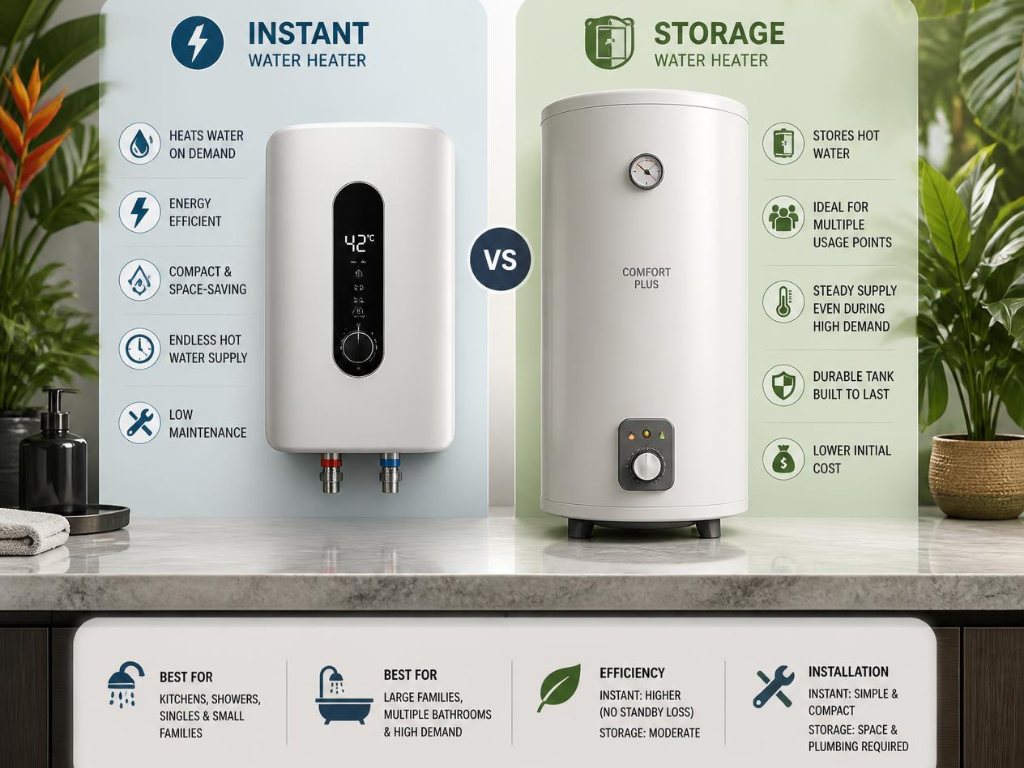
For a standard HDB bathroom used by one or two people, an instant heater is the better fit. For a household of four sharing consecutive showers, or any bathroom with a rain shower head or a bathtub, a storage heater performs better.
Flow rate is the deciding variable. Instant heaters heat water as it passes, so raising the flow reduces the temperature rise, which is why an instant unit paired with a wide rain shower head produces water that feels lukewarm. A rain shower demands more litres per minute than a compact element can lift to shower temperature in a single pass.
Occupancy is the second variable. Four consecutive showers in one morning will empty a 30-litre tank, and recovery takes time. An instant heater never runs out, which is the argument for it in shared flats where shower timing is unpredictable.
In practice, most four-room and five-room HDB flats we work in end up mixed: an instant unit in the common bathroom and a storage tank in the master, sized to the rain shower. That combination costs more upfront than two instant units and less than two tanks.
How much power does each one draw, and will your DB box take it?
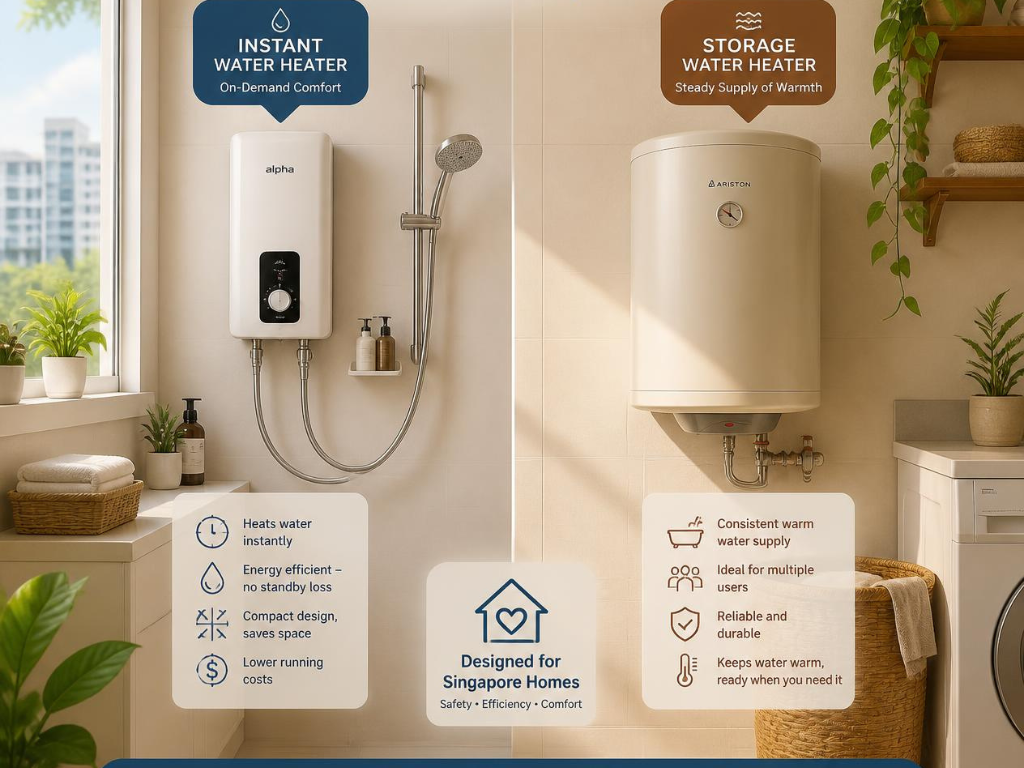
Instant heaters draw far more current at the moment of use, and that is the constraint most households discover too late. An 8.8kW instant heater pulls roughly 38 amps at 230 volts, which needs a dedicated circuit and adequate spare capacity at the distribution board.
Storage heaters are gentler on the board. A 3kW element draws about 13 amps, comparable to a kettle, and it cycles rather than running flat out. Older HDB flats with limited DB capacity often accommodate a storage heater with no board work at all, while the same flat needs a new circuit for a high-output instant unit.
Both need an isolator switch, a dedicated double-pole switch that cuts power to the heater independently, and both must be protected by a residual current circuit breaker. Singapore Standard SS 638:2018, the Code of Practice for Electrical Installations, governs how that circuit is designed and terminated.
Check the board before you shop. Counting spare ways in the DB, confirming the RCCB rating, and establishing whether the existing heater circuit can carry a higher-rated unit are all questions for electrical installation work rather than the appliance retailer, and getting the answer first prevents buying a heater the flat cannot power.
What does each one cost to run in 2026?
Storage heaters cost more to run in a low-usage household and less in a high-usage one. The crossover sits at roughly two showers a day, because a tank pays a standby penalty whether you use it or not.
Price the difference at the current rate. EMA sets the regulated tariff quarterly, and for July to September 2026 it is “31.91 cents/kWh (before GST), or 34.78 cents/kWh (with GST).” A 6kW instant heater running eight minutes a day consumes 0.8kWh, costing about 28 cents daily or $8.50 a month. A 3kW storage heater holding a 30-litre tank typically draws 1 to 1.5kWh a day including standby reheating, landing between $10 and $16 monthly.
Those figures moved sharply this year. SP Group raised household tariffs by 17.0 per cent, or 4.64 cents per kWh, from 1 July 2026, adding $17.14 to the average monthly bill of a four-room HDB household before GST. Standby loss on a storage tank costs measurably more in August than it did in May.
The stance we take with clients is straightforward. Running cost differences between the two types run to single-digit dollars monthly, so choosing on energy alone is optimising the wrong variable. Choose on flow rate and household size, then reduce the storage heater’s standby cost by switching it off at the isolator between uses.
How long does a storage heater take to heat up?
A 30-litre storage heater reaches usable temperature in roughly 15 to 25 minutes from cold, depending on element rating and incoming water temperature. Recovery after partial use is faster, because only the drawn volume needs reheating.
Element rating sets the pace. A 3kW element heats a given tank in roughly half the time a 1.5kW element takes, which is why two tanks of identical capacity perform differently. Singapore’s incoming mains water sits warm year-round, which shortens heat-up compared with temperate climates and is one reason smaller tanks work here than would be viable elsewhere.
Standing habits matter more than specifications. Households that switch the heater on twenty minutes before showering get tank performance without paying full standby cost. Households that leave it on continuously pay for reheating a tank nobody is using.
An instant heater has no recovery time at all. Hot water arrives within seconds of opening the tap and continues indefinitely, which is the single strongest argument for instant units in flats with irregular schedules.
Do you need one heater per bathroom or one for the whole flat?
Single-point heaters serve one outlet and multipoint heaters serve several. Almost every instant heater sold for Singapore homes is single-point, feeding the shower it is mounted beside, while storage heaters are commonly multipoint.
The distinction changes the pipework. A single-point instant unit takes a cold feed and outputs directly to the shower, so installation stays contained within the bathroom. A multipoint storage tank feeds the shower, the basin and sometimes the kitchen through a hot water line running across the flat, which means concealed piping and a larger job.
Retrofit reality favours single-point in existing flats. Running a new hot water line through a finished HDB flat means chasing walls or boxing in pipework, so households replacing a failed heater usually stay with the configuration already installed.
Where this breaks down is kitchens. Hot water at a kitchen sink is uncommon in Singapore HDB flats and rarely worth retrofitting a multipoint system for, so a compact under-sink unit is the cleaner answer where a household wants it.
Does installing a storage heater need a licensed plumber?
Yes. Storage water heater installation is regulated water service work requiring a PUB Licensed Plumber, and the distinction against instant heaters is written into PUB’s own rules.
PUB publishes a list of simple plumbing works a handyman can carry out without a licence. On the potable water side, that list includes replacing or removing any pipe “between a stop valve and an instantaneous water heater.” Storage water heaters appear nowhere in PUB’s simple works schedule, which places their installation and replacement in the regulated category. Since 1 April 2018, engaging an unlicensed plumber for regulated water service works has been an offence.
The compliance work is real, not paperwork theatre. A storage installation needs specified valves to prevent backflow contaminating the supply, and a drainage path for the pressure relief discharge, both built to Singapore Standard SS 636:2018. Most manufacturers also void the warranty on a heater installed outside those requirements.
Budget for it. The licensed component is a genuine cost difference between the two options that appliance pricing never shows, and it is one reason a storage heater’s installed cost exceeds an instant unit’s by more than the appliance price gap suggests. The same boundary appears in the HDB rules on regulated works for anyone renovating a bathroom.
What clearance and mounting does each one need?
Instant heaters mount on the bathroom wall beside the shower at roughly shoulder height, needing only enough clearance to open the front cover for servicing. Storage heaters need considerably more.
Weight drives the requirement. A 30-litre tank holds 30 kilograms of water plus the unit’s own mass, so the mounting wall must carry that load permanently, and hollow partition walls will not. Tanks are commonly fitted above a false ceiling or on a structural wall in the service yard for this reason.
Service access is the constraint people forget. A storage heater needs room to withdraw the heating element for descaling and eventual replacement, typically a clear span in front of the unit roughly equal to the element’s length. Tanks boxed tightly into a false ceiling without an access hatch become a hacking job at the first fault.
Both types need the pressure and discharge arrangements terminated correctly. A storage tank’s pressure relief valve must discharge to a visible, safe point rather than into a concealed void, which is one of the more common defects we find on heaters installed by unlicensed hands.
Which one lasts longer, and what fails first?
Storage heaters typically last eight to twelve years in Singapore; instant heaters run five to ten. The failure modes differ enough to matter when you are weighing replacement cycles.
Storage tanks fail from the inside. The tank corrodes, the sacrificial anode depletes, and scale accumulates on the element until heating slows. A leaking storage tank is the terminal fault and it floods a bathroom, which is why a tank fitted above a false ceiling deserves a drip tray and a drainage path.
Instant heaters fail at the element or the flow sensor. A unit that runs cold at normal flow but hot at a trickle usually has a degraded element; one that produces no heat at all often has a failed flow switch that never triggers heating. Both are diagnosable in minutes, and our water heater troubleshooting tips cover the sequence.
Replacement economics favour instant units. A failed instant heater is swapped for a few hundred dollars with contained pipework; a failed storage tank brings the licensed plumber, the PUB submission and the valve work back into play every time.
What size storage tank do you need?
Size to consecutive showers, not to household size. A 30-litre tank comfortably covers two back-to-back showers, 50 litres covers three to four, and a bathtub or rain shower pushes the requirement toward 60 litres or more.
The common Singapore sizes reflect that. 15-litre units suit a single-point basin or a compact shower, 25 to 30 litres is the standard master bathroom fitting, and 50 to 100 litres appears in landed properties feeding multiple outlets from one tank.
Oversizing carries a running cost. A tank holds its full volume at temperature regardless of how much you draw, so a 60-litre unit serving one person pays standby loss on 60 litres to use 15. Undersizing carries a comfort cost and a recovery wait, and households consistently regret undersizing more than oversizing.
Mixing matters too. A storage heater blends with cold at the mixer, so a 30-litre tank at 60 degrees delivers considerably more than 30 litres of shower-temperature water, which is why tanks perform better in practice than their nominal capacity suggests.
What each one actually costs to install
Instant heaters install cheaper because the work stays unregulated and contained. Fix It Papa’s published rates start at $120 for water heater installation, with tap and faucet work from $50.
Three cost components separate the two. The appliance itself, where instant units and small storage tanks overlap heavily in price. The electrical work, which favours storage heaters in older flats because a lower draw often avoids a new circuit. And the licensed plumbing plus PUB submission, which applies to storage installations and not to instant pipework.
Circuit work is the variable that surprises people. Where an 8.8kW instant heater needs a new dedicated circuit run from the DB, that job can exceed the heater’s own price, and it is invisible until someone opens the board.
After-hours and public holiday attendance carries a surcharge on either job, and our published plumbing rates put that at $50 to $150 on top. Where a heater is being replaced rather than newly installed, heater supply and fitting usually reuses the existing circuit and pipework, which keeps the job to a single visit.
Conclusion
The choice is decided by flow rate and distribution board capacity, not by energy efficiency, because the running cost gap between the two types is single-digit dollars a month even at July 2026’s record tariff. Rain showers and consecutive users point to a tank; compact showers and irregular schedules point to instant. The hidden variable is compliance, since only one of the two brings a PUB Licensed Plumber and a submission into the job.
Photograph your distribution board and your existing heater, then request a quote so the circuit capacity and the regulated scope are confirmed before you buy an appliance the flat cannot take.
Frequently asked questions
Is an instant or storage water heater cheaper to run in Singapore?
An instant heater is cheaper for one or two showers a day because it carries no standby loss. A storage heater wins in high-usage households. At the July 2026 regulated tariff of 34.78 cents per kWh including GST, the monthly gap between them is under $8 for a typical flat.
Can a handyman install my water heater?
Only an instant heater’s supply pipework. PUB permits replacing any pipe between a stop valve and an instantaneous water heater as simple plumbing works, but storage water heater installation is regulated and requires a PUB Licensed Plumber. Engaging an unlicensed plumber for regulated works has been an offence since 1 April 2018.
What size storage water heater is right for an HDB bathroom?
A 30-litre tank suits most HDB master bathrooms and covers two consecutive showers. Choose 15 litres for a single-point basin or compact shower, and 50 litres or more where a bathtub or rain shower is fitted. Oversizing raises standby cost without improving performance.
Why does my instant water heater run lukewarm?
Flow rate exceeds what the element can heat in a single pass. Reduce the flow at the mixer, or check whether a wide rain shower head was fitted after installation. An 8.8kW unit lifts temperature roughly twice as effectively as a 3.3kW one at the same flow.
Should I switch my storage water heater off between uses?
Yes, at the isolator switch rather than the wall socket. A 30-litre tank reheats in 15 to 25 minutes, so switching on twenty minutes before showering removes most standby cost. Leaving a tank powered continuously is the single largest avoidable cost in either system.
Leave a Reply
You must be logged in to post a comment.