
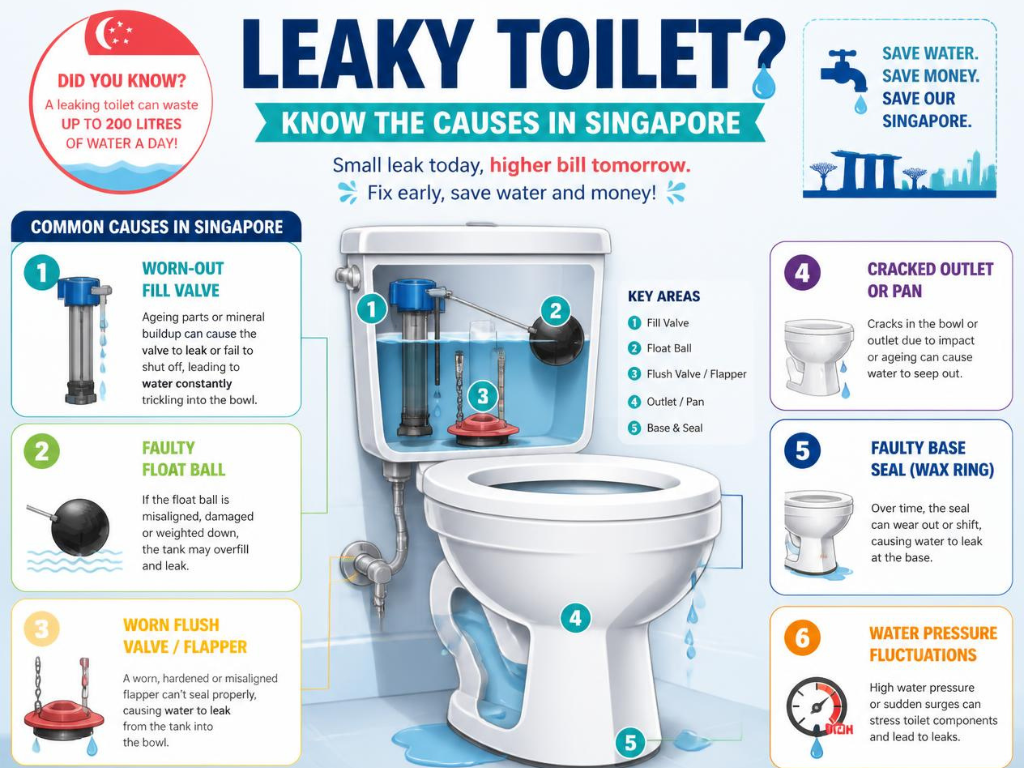

A toilet leaking from the base in Singapore carries a liability most homeowners never see coming. HDB’s Goodwill Repair Assistance scheme covers floor-slab leaks from wear and tear at 50 per cent, but a leak from your own fixture falls outside it entirely. This blog walks you through finding the source, and why re-seating a bowl is licensed plumbing work.
Why is there water around the base of my toilet?
Water at the base comes from one of four sources, and they are easy to confuse. Condensation on the ceramic, a leaking tank-to-bowl connection running down the outside, a failed seal beneath the bowl, or seepage rising through the floor from a failed waterproofing layer.
Only one of those four is what people usually assume. A failed wax ring produces water at the base, but so do the other three, and the repair paths diverge sharply. Condensation costs nothing to fix. Slab seepage becomes a floor-hacking job and a conversation with the neighbour below.
Timing separates them faster than anything else. Water that appears only during and just after a flush points beneath the bowl or at the tank joint. Water present constantly, with the toilet unused, points at the supply connection or the floor. Water that appears on humid days and dries by afternoon is condensation.
Getting this right before anyone starts work matters. Singapore’s high-rise housing puts somebody’s ceiling directly under your bathroom, and the source of the water determines who carries the cost.
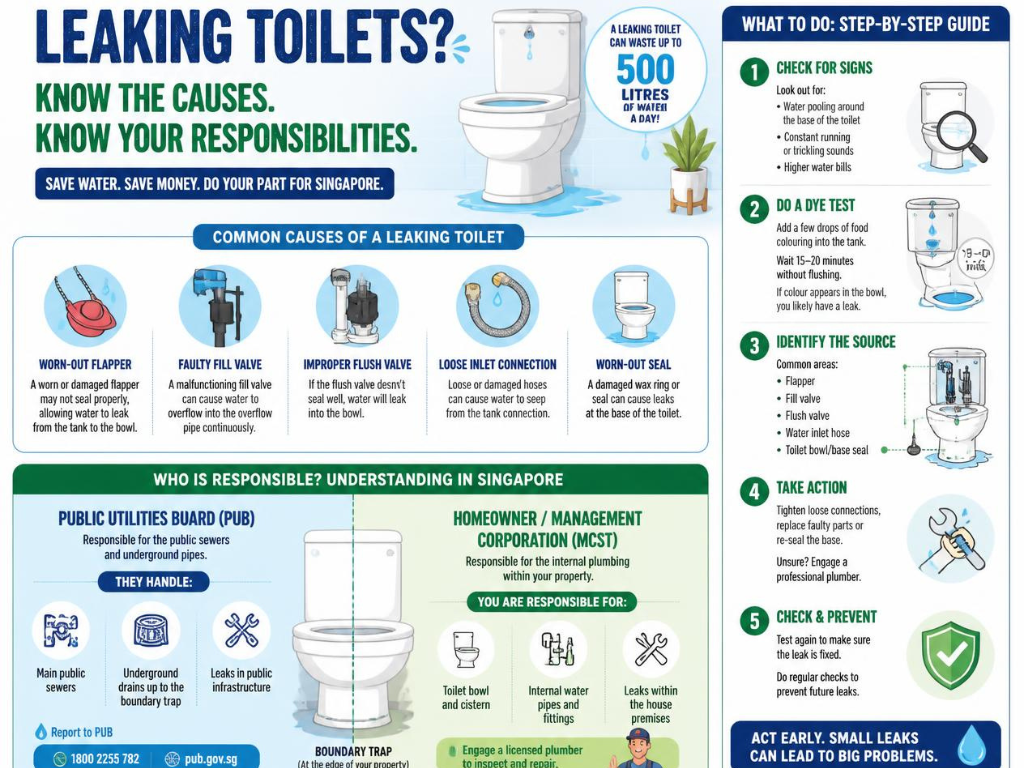
Is it a leak, or is it just condensation?
Condensation forms on the outside of the cistern and bowl when cold supply water chills the ceramic below the dew point of humid bathroom air. Singapore’s climate makes this common, and it is the single most over-diagnosed cause of water at a toilet base.
Test it with a dry towel. Wipe the entire outside of the cistern and bowl completely dry, then leave the toilet unused for two hours with the door shut. A film of fine droplets reforming evenly across the whole ceramic surface is condensation. Water pooling at one point on the floor with the ceramic still dry above it is a leak.
The pattern on the floor confirms it. Condensation drips off the lowest point of the cistern and lands in a line rather than a ring, and it never appears under the front of the bowl. A wax ring failure puts water around the base perimeter, heaviest at the rear where the discharge sits.
Ventilation fixes the condensation version. An extractor fan running during and after showers cuts humidity enough to stop the ceramic sweating, and no plumbing work is involved.
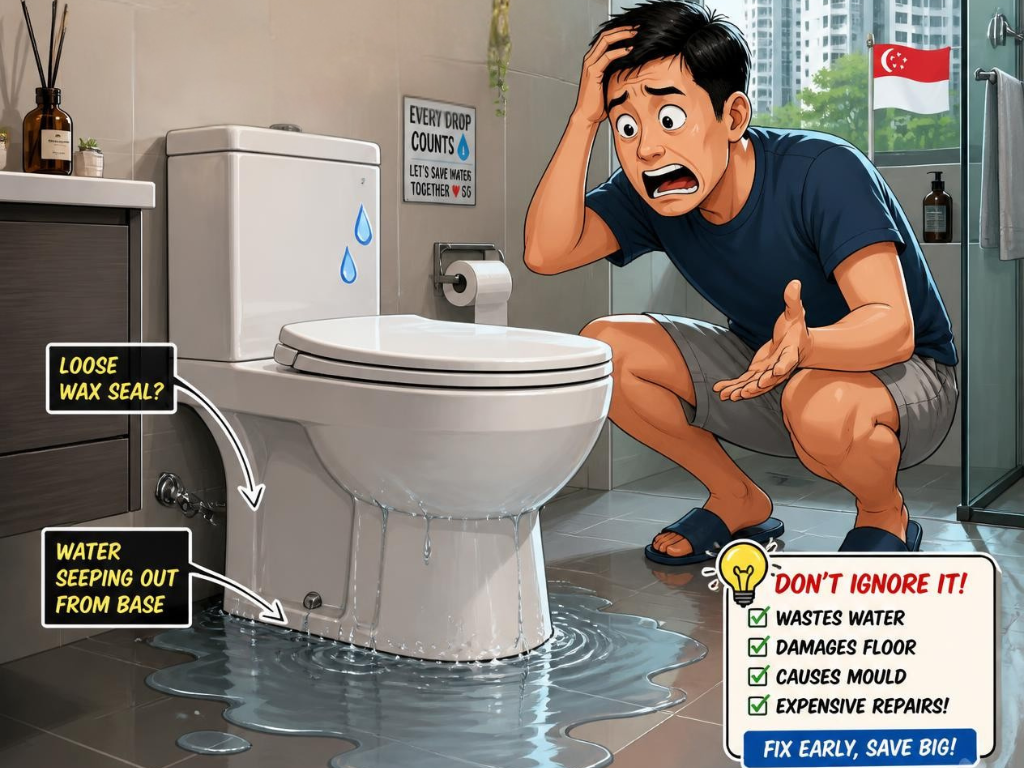
Does the water only appear when you flush?
Water appearing at the base during a flush and stopping afterwards means the seal beneath the bowl has failed. Flushing briefly pressurises the discharge path, and a compromised wax ring lets a small volume escape sideways at the floor before the water clears the trap.
Confirm it with tissue. Dry the floor completely, lay a ring of toilet paper around the base, then flush once and watch. Paper darkening at the rear within seconds isolates the fault to the seal or the flange beneath. Paper staying dry through three consecutive flushes moves the diagnosis elsewhere.
A flush-only leak rarely stays small. Every flush pushes more water into the screed under the bowl, and that water travels laterally before it finds the slab. Households often report a base leak that seemed trivial for months, followed by a neighbour complaining about a ceiling stain.
Where this breaks down is in bowls that leak only on full flush and not on reduced flush. That points to a marginal seal that fails above a certain volume, and marginal seals do not recover. The bowl needs lifting and re-seating.
Does your toilet even have a wax ring?
Not all of them do, and this is where imported repair advice fails in Singapore homes. An S-trap bowl discharges vertically through the floor onto a flange, sealed with a wax ring. A P-trap bowl discharges horizontally into a wall outlet through a pan connector, with no wax ring anywhere beneath the base.
Singapore uses both. S-trap installations dominate older HDB flats where the soil pipe runs down through the slab. P-trap installations appear in newer builds and many condominium bathrooms where the discharge runs horizontally into a boxed-in wall stack. The trap type is set by the building, not by preference, which is why buying a replacement bowl means matching the existing configuration before anything else.
Check the outlet position. A bowl sitting flush to the floor with no visible pipe behind it is an S-trap. A bowl with a short horizontal spigot entering the wall a few centimetres above floor level is a P-trap.
The diagnostic consequence is direct. On a P-trap installation, water at the base is never a wax ring failure, because there is no wax ring. It is the pan connector, the tank joint, the silicone base seal, or the floor. Take the stance plainly: if a guide tells you to replace the wax ring without asking which trap you have, it was not written for Singapore bathrooms.
Why is my toilet rocking, and does that cause the leak?
A rocking toilet causes seal failure rather than resulting from it. Movement under body weight works the wax ring loose from the flange, breaking the compression that made it watertight.
Three things produce the rock. Mounting bolts that have loosened or corroded through, an uneven floor screed leaving the bowl bearing on two points instead of a full footprint, or a cracked floor flange no longer holding the bolts securely. Corroded bolts are the most common in Singapore bathrooms, where constant humidity attacks the fixings faster than in dry climates.
Tightening the bolts is a tempting first move and usually the wrong one. Overtightening cracks vitreous china, and a hairline crack in the bowl foot turns a $50 seal problem into a full bowl replacement. Nuts should go finger-tight plus a quarter turn, alternating sides, and never further.
A toilet that rocks needs lifting regardless. The seal beneath has already been compromised by the movement, so re-tightening a rocking bowl onto a deformed wax ring buys weeks at best.
Could the water be coming from the tank instead of the base?
Water running down the outside of the bowl from above pools at the base and looks identical to a base leak. The tank-to-bowl gasket and the tank mounting bolts are the two culprits, and both sit at the joint where a two-piece cistern meets the bowl.
Trace it upward with a dry hand. Run your fingers along the underside of the cistern where it meets the bowl, then down the back. Moisture on that path means the fault is at the tank joint. Dry ceramic with water still pooling means the source is below.
The tank-to-bowl gasket is a rubber doughnut compressed between cistern and bowl by two or three bolts, and it hardens with age like every other rubber seal in the assembly. Tank bolts corrode too, and a weeping bolt washer produces a slow drip that reaches the floor at one specific point rather than around the perimeter.
Worth noting: a leak at this joint is external, running onto the floor. A cistern leaking internally into the bowl is a different fault entirely, produces no water on the floor, and shows up as a toilet that keeps running rather than a wet base.
When is water at the base actually floor seepage?
Water rising through the tile grout around the toilet rather than escaping from the fixture means the waterproofing membrane in the floor has failed. The toilet is then a bystander, and no amount of re-sealing the base stops it.
The signature is spread. Fixture leaks concentrate at the bowl footprint. Membrane failure produces dampness across a wider area of floor, often extending toward the floor trap or the shower zone, and the grout lines stay dark long after the surface is dried. Persistent musty smell and tile edges lifting confirm it.
Singapore bathrooms are built with a waterproofing membrane laid over the structural slab, then a screed layer, then tiles. The membrane is a consumable with a service life. HDB attributes ceiling leaks to the waterproof membrane and screed deteriorating through natural wear and tear, and identifies them as particularly common in older flats, concentrated in bathrooms and toilets.
Repair means reaching that membrane. HDB names re-screeding as the most effective solution, which involves removing tiles to replace the membrane and screed beneath, with alternative methods available depending on severity and location. Where you suspect the membrane rather than the bowl, the right next step is to trace a concealed leak before anyone lifts a toilet.
Who pays if it leaks into the flat below?
The answer turns on the source, and the difference runs into four figures. Where a leak comes from the floor slab through wear and tear, HDB treats maintenance as a shared responsibility between the upper and lower flat owners, who agree repair arrangements and split the cost. HDB’s Goodwill Repair Assistance scheme softens that further, with HDB co-paying 50 per cent and the two owners covering 25 per cent each.
A leak from your own fixture sits outside that framework. HDB makes owners responsible for the fittings and fixtures inside the flat, sanitary fittings explicitly among them, so a failed wax ring or tank gasket is yours alone. Your fixture, your slab damage, your cost, and the Goodwill scheme does not apply because the fault is not slab wear and tear.
Position in the block changes the answer again. Top-floor leaks trace to the roof, which is common property maintained by the Town Council rather than either owner. A second-floor flat leaking into the void deck splits the cost between the owner and the Town Council. For condominiums the equivalent framework runs through the MCST and its managing agent, not HDB.
Damage to the neighbour’s belongings sits outside every scheme. Ruined cabinetry, light fittings and false ceilings are settled directly between the two households.
Tell your downstairs neighbour early. A base leak reported at the tissue-test stage is a $200 conversation; the same leak reported after a ceiling stain appears is a cost-sharing negotiation with a stranger.
Can I fix a toilet base leak myself, or does it need a licensed plumber?
Re-seating a toilet bowl requires a PUB Licensed Plumber. PUB’s schedule of simple plumbing works that handymen can carry out lists washbasins, sinks, bathtubs, shower trays, floor waste outlets and urinals, and it permits clearing a blockage in a water closet, but installing, replacing or removing a water closet is not on that list.
That single omission decides the question. Replacing a wax ring means lifting the bowl off the flange and re-seating it, which is regulated sanitary plumbing work. Since 1 April 2018, engaging a plumber not licensed by PUB for regulated water service or sanitary plumbing works has been an offence, and PUB sets out the full scope of what falls where.
Newer flats carry a second reason for restraint. HDB gives new flat owners a five-year warranty against ceiling leakage and external seepage, and that warranty ceases if the floor tiles are changed or the waterproofing system is tampered with. Lifting a bowl and disturbing the screed around the flange is exactly the kind of work that puts it at risk, on top of the one-year defect liability period HDB already covers.
Plenty stays open to you. Drying and testing, running the tissue and towel checks, improving ventilation, and re-applying anti-fungal silicone around an intact base are all outside the regulated scope. Tightening mounting bolts sits in a grey zone and carries the crack risk described earlier, so it is rarely worth it.
Fix It Papa runs handymen and PUB-licensed plumbers under one roof, which is why the trap type and leak source get established before a technician is assigned. The same boundary governs HDB renovation plumbing limits for anyone doing bathroom work.
What does fixing a toilet base leak cost in Singapore?
Cost tracks the source, not the symptom. Silicone re-sealing and ventilation fixes sit at the bottom; slab waterproofing sits at the top and involves the flat below.
Three bands cover most jobs. A tank-to-bowl gasket or tank bolt replacement is a short visit plus a low-cost part. A full re-seat with a new wax ring means lifting the bowl, cleaning the flange, replacing bolts and re-seating, which is a licensed job running one to two hours. Waterproofing repair is a different category altogether, priced as minor renovation with hacking, membrane, screed and retiling, and it moves into GRA territory once the slab is involved.
Fix It Papa’s published plumbing rates start at $50 for tap and faucet work, with toilet bowl choke clearing from $80. After-hours and public holiday attendance adds a surcharge, and what plumbers charge in 2026 puts that band at $50 to $150 on top.
Diagnosis first is the cheaper path. Committing to a re-seat when the actual fault is a failed membrane means paying for the wrong repair and still owning the leak.
Conclusion
Four sources put water around a toilet base and only one of them is the wax ring everybody blames first. Establishing which one you have is worth more than any repair decision, because the source determines whether HDB co-pays 50 per cent under Goodwill Repair Assistance or you carry the neighbour’s ceiling alone. Re-seating the bowl is regulated work either way, and has been since 1 April 2018.
Run the towel test and the tissue test tonight, then arrange a site inspection with photos of the base and the discharge outlet so the trap type and the correct scope are confirmed before work starts.
Frequently asked questions
Is a leaking toilet base an emergency?
No, but it stops being cheap fast. Water escaping at the base soaks the screed under the bowl and travels toward the floor slab, which brings HDB’s inter-floor leakage framework and your downstairs neighbour into it. Fix It Papa treats a confirmed base leak as a same-week job, not a same-hour one.
Can I just seal around my toilet base with silicone?
Only where the base seal itself is intact and you are refreshing it. Sealing over a failed wax ring traps water under the bowl instead of stopping it, and the water still reaches the slab. Re-seating requires lifting the bowl, which PUB classifies as work for a Licensed Plumber.
How do I know if the leak is from the toilet or the floor?
Dry the area, then check the spread. Fixture leaks concentrate around the bowl footprint; membrane failure dampens a wider floor area and darkens grout lines near the floor trap. HDB attributes most inter-floor leaks to wear and tear of waterproofing and screed, common in flats over twenty years old.
Does HDB pay for a toilet leak damaging my neighbour’s ceiling?
Only when the leak is floor-slab wear and tear. Under the Goodwill Repair Assistance scheme HDB pays 50 per cent and the two flat owners pay 25 per cent each. HDB has confirmed that leaks from pipes or fixtures inside a flat fall outside the scheme, leaving the owner fully responsible.
Why is my toilet rocking after I tightened the bolts?
The floor screed under the bowl is uneven, so the base bears on two points and no amount of tightening seats it flat. Plastic shims level it during a proper re-seat. Overtightening cracks vitreous china, turning a wax ring job into a full bowl replacement.
Leave a Reply
You must be logged in to post a comment.