
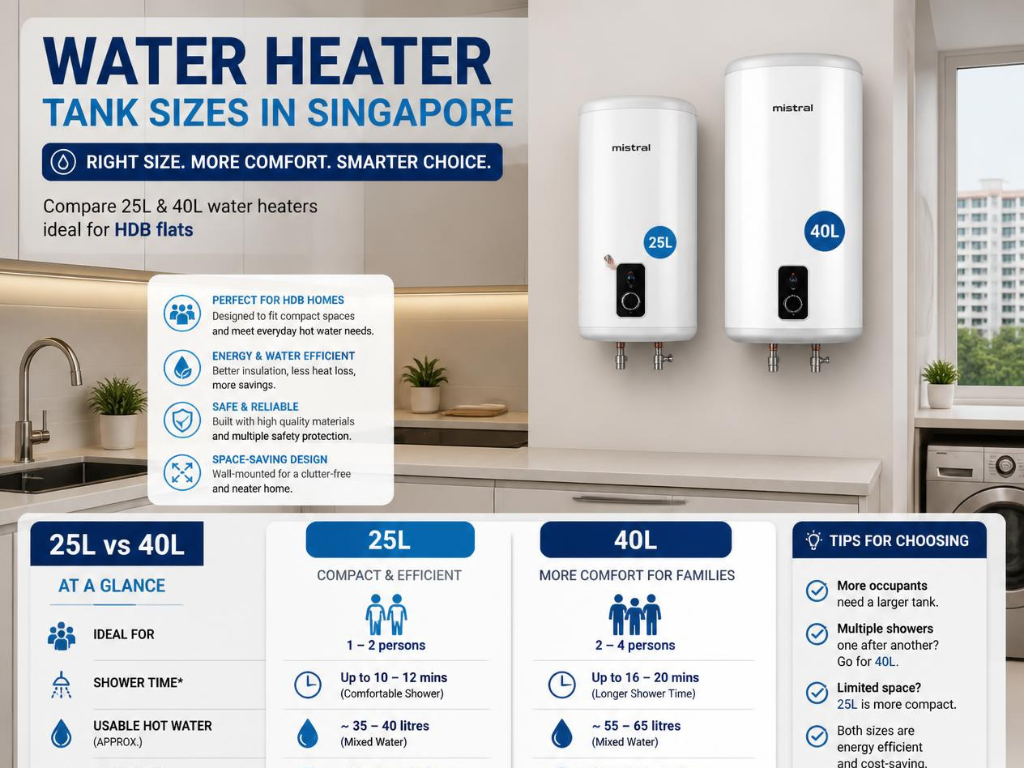

Getting the water heater tank size right in Singapore matters more than most households realise, because the sizing charts they consult were written for temperate climates. A PUB household study run across roughly 400 homes in 2024 and 2025 found showering is the largest water-consuming activity in Singapore homes. This blog walks you through the arithmetic that sets tank capacity, before you book home plumbing services.
What size storage water heater do you actually need?
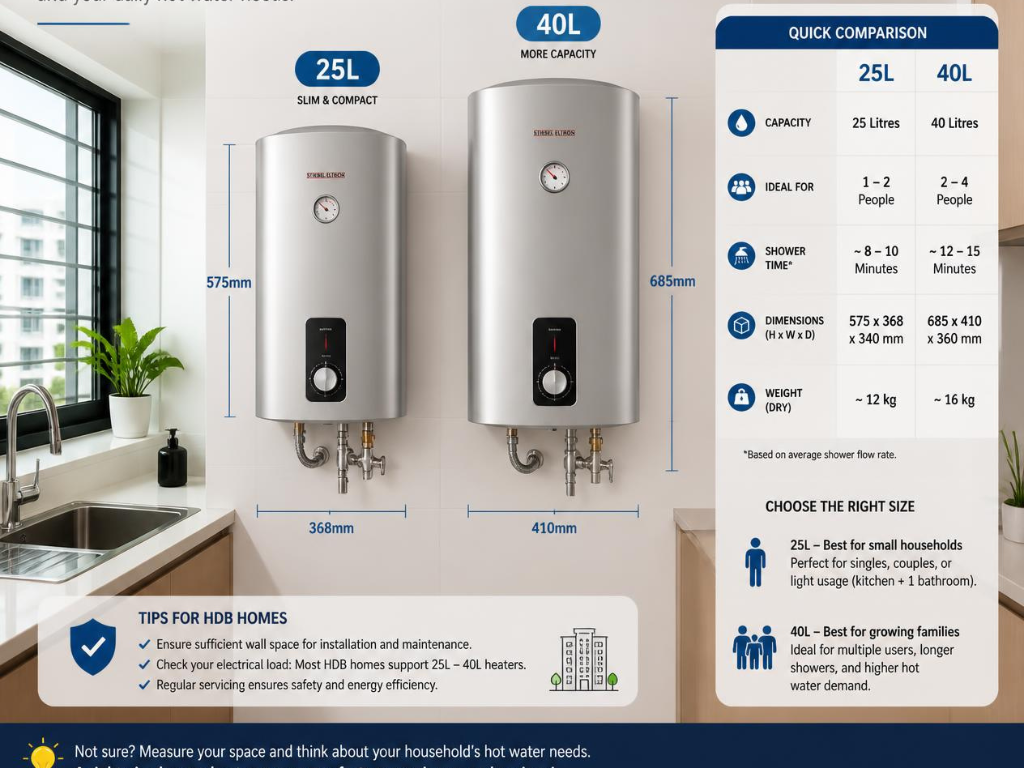
For a single HDB or condo bathroom used by up to four people, a 25-litre tank is sufficient. Move to 40 litres only where a bathtub, a rain shower head, or more than four consecutive showers are involved.
That answer runs against most sizing advice sold in Singapore, and the reason is arithmetic rather than opinion. Households size tanks as though a 25-litre tank delivers 25 litres of shower water. It delivers closer to 67, because the tank water is blended with cold at the mixer before it reaches you.
Three variables set the requirement. The volume of a single shower, the number of showers taken back to back without a recovery gap, and the temperature of the incoming mains water that dilutes the tank output.
Singapore’s mains temperature is what breaks the imported charts. Water arriving at a Singapore flat sits close to ambient, around 28°C year-round, while a UK or Australian sizing chart assumes mains water near 10°C. The same tank does substantially more work here, which is why a 25-litre unit is a normal master bathroom fitting in Singapore and would be considered undersized in London.
How much hot water does one Singapore shower really use?
Around 20 litres. That figure comes from measurement rather than estimation, and it is materially lower than the 40 to 80 litres that generic sizing guides assume.
NUS Business School and its Department of Real Estate ran a study with PUB across about 500 HDB households over four to six months, fitting smart shower devices that recorded more than 300,000 individual showers. Writing up the findings, Professors Sumit Agarwal and Tien Foo Sing reported that “Singaporeans use almost 20 litres of water in a single shower” lasting roughly five minutes.
The gap between that number and the assumptions in most sizing guides explains a lot of oversized tanks. A guide assuming a 60-litre shower will recommend triple the capacity a Singapore household needs for the same number of users.
Behaviour narrows it further. The same study found households given a 15-litre target cut consumption by 3.9 litres per shower, around 19 per cent, so the real figure in a water-conscious household sits below 20 litres. Worth noting: this is measured Singapore data on Singapore showering habits, which no imported chart reflects.
Why does a 25-litre tank give you more than 25 litres of hot water?
Because you never shower at tank temperature. A storage heater holds water near 60°C, a comfortable shower runs around 40°C, and the mixer blends the two using cold mains water to bridge the gap.
The proportion is calculable. With mains water at 28°C, reaching 40°C from a 60°C tank requires a hot fraction of roughly 37 per cent, since the temperature lift needed from the tank represents 12 degrees out of an available 32. Every litre drawn from the tank therefore produces about 2.7 litres of shower-temperature water.
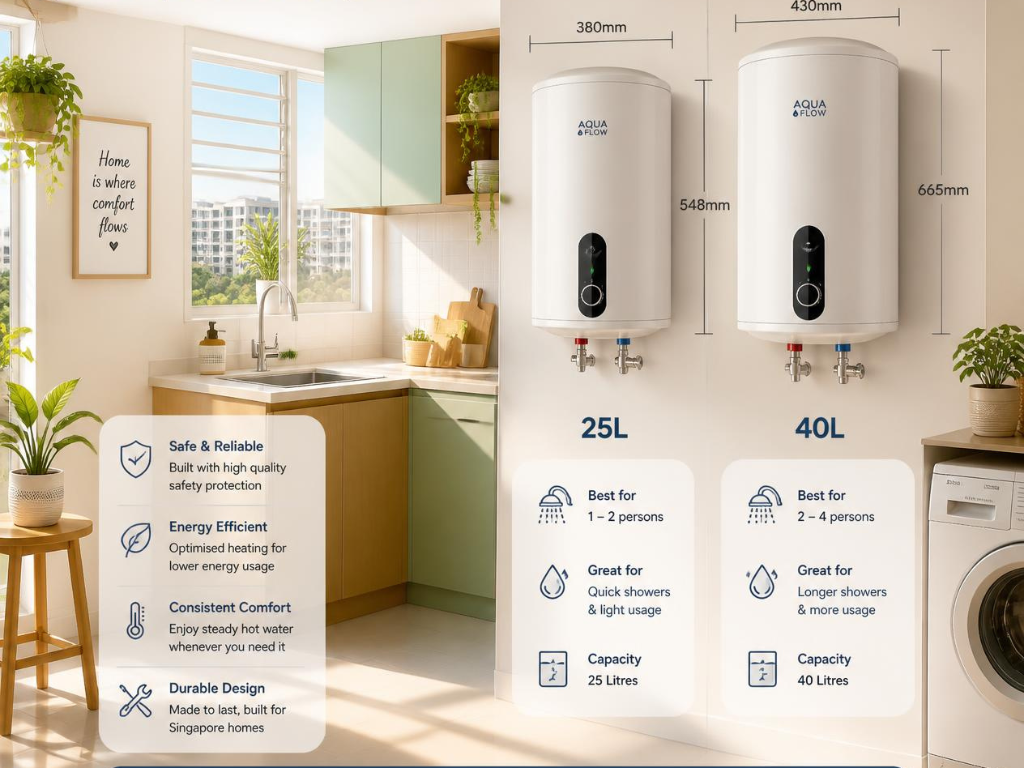
Run that against the tank sizes sold here. A 25-litre tank yields roughly 67 litres of 40°C water. At the NUS-measured 20 litres per shower, that covers three consecutive showers before the tank needs recovery time, and a fourth if the last person is quick.
This is where Singapore diverges sharply from temperate markets. In a country with 10°C mains water, the hot fraction rises to 60 per cent and the same 25-litre tank yields only about 42 litres of shower water. Singapore households get roughly 60 per cent more usable output from identical hardware, purely because the cold water is warm.
Is a 25L or a 40L tank right for a single bathroom?
25 litres for a standard shower, 40 litres once a bathtub or rain shower head is fitted. Bathroom count matters less than what is hanging on the wall inside it.
A standard shower head paired with a 25-litre tank serves a household of four comfortably, because the showers rarely happen simultaneously and the tank recovers between the morning and evening peaks. The failure case is four people showering consecutively in under an hour, which happens in households with synchronised schedules and rarely otherwise.
A 40-litre tank buys headroom rather than necessity in most flats. It yields around 107 litres of blended output, covering five consecutive showers, and it costs more in standby heat loss for every day that headroom goes unused.
The stance we take on site is to size for the actual peak, not the theoretical one. Households consistently describe a worst case that occurs twice a year, then pay standby loss on the extra capacity for the other 363 days. Where the peak genuinely is four back-to-back showers every weekday morning, 40 litres earns its place.
What size water heater suits a family of four?
A single 25-litre tank per bathroom covers a family of four in most Singapore flats. Families with two bathrooms rarely need more than 25 litres in each, because the load splits across both.
Consecutive use is the constraint, not headcount. Four people showering across a two-hour window place almost no strain on a 25-litre tank, since it recovers partially between each draw. The same four people showering within 40 minutes will exhaust it, and that is the scenario worth designing around if it describes your mornings.
Household composition shifts the number. Young children take short showers and often share bath water, which reduces demand well below the per-person figure. Teenagers do the opposite, and a household with two teenagers is the most common case where we recommend moving up a size.
Per capita context helps calibrate. Singapore household water consumption averaged 141 litres per person per day in 2025, with the Singapore Green Plan 2030 targeting 130. PUB’s study of about 400 households found showering, flushing, kitchen and laundry together account for about 80% of total household water use.
Does a rain shower or bathtub change the sizing?
Both push you to 40 litres minimum, and a rain shower changes flow rate rather than volume. A wide rain head moves considerably more water per minute than a standard head, so the same five-minute shower draws far more from the tank.
Flow rate is the mechanism. A standard shower head running at 7 litres per minute uses 35 litres over five minutes, of which roughly 13 comes from the tank. A rain head at 15 litres per minute uses 75 litres in the same five minutes, drawing about 28 from the tank, which means one rain shower consumes most of a 25-litre unit.
Bathtubs are simpler to size because you fill them once. A standard bathtub holds 150 to 200 litres, needing roughly 56 to 75 litres from the tank at Singapore mains temperature, which puts a 60-litre unit at the minimum for anyone who actually uses the tub.
Rain showers and instant heaters pair badly for the same reason they stress small tanks. Where a rain head is fitted, the storage tank is the correct answer, sized to the head rather than to the household.
How does your showerhead’s WELS rating affect tank size?
Directly, because the WELS tick rating tells you the flow rate, and flow rate multiplied by shower duration gives you the volume the tank must serve. A 3-tick head flows below 5 litres per minute; a 2-tick head sits between 5.0 and 7.0.
Check the rating before choosing the tank. A household with 3-tick heads throughout runs at under 5 litres per minute, so a five-minute shower consumes under 25 litres total and under 10 from the tank. That household is comfortably served by 15 to 25 litres of storage regardless of headcount.
An unrated or older head changes the calculation entirely. Non-rated heads commonly flow at 10 to 12 litres per minute, doubling the tank draw for an identical shower, and upgrading the head is cheaper than upgrading the tank.
Note the scheme’s boundary. PUB’s Mandatory Water Efficiency Labelling Scheme covers taps and mixers, dual-flush cisterns, urinal flush valves and washing machines, while showerheads fall under the voluntary arm. The tick rating on a shower head is reliable when present, but it is not guaranteed to be there.
What happens if you oversize the tank?
You pay standby heat loss on capacity you never draw. A tank holds its entire volume at temperature continuously, so a 60-litre unit serving one person reheats 60 litres to deliver 10.
The cost is real and rising. Household electricity reached 34.78 cents per kWh including GST from 1 July 2026, a 17 per cent quarterly increase and the highest household rate on record, which makes every litre of unused standing capacity more expensive than it was in May.
Physical cost compounds the running cost. A 60-litre tank weighs 60 kilograms filled, needs a structural wall or reinforced ceiling support, occupies more of a false ceiling void, and costs more to install and eventually replace. None of that is recovered by capacity nobody uses.
Where this breaks down is the households that undersize instead. Running out mid-shower is a daily irritation and no amount of efficiency justifies it, so the cleaner approach is to calculate the genuine peak, then take the next size up only if the peak sits within about 15 per cent of the tank’s usable output.
How long does the tank take to recover between showers?
A 25-litre tank with a 3kW element reheats from cold in roughly 15 to 20 minutes, and partial recovery after a single shower takes considerably less because only the drawn volume needs reheating.
Element rating drives the pace more than capacity does. A 3kW element restores a given tank in roughly half the time a 1.5kW element takes, so two 25-litre units with different elements behave like different products. Where a household showers consecutively, a higher element rating substitutes for extra capacity at lower standby cost.
Singapore’s warm mains shortens recovery too. Heating water from 28°C to 60°C requires a 32-degree lift, against 50 degrees in a temperate climate, so the same element recovers a Singapore tank noticeably faster.
Habit closes the remaining gap. Switching the heater on 20 minutes before the first shower delivers full tank performance without paying continuous standby, and households that adopt that pattern rarely need the larger tank they were considering.
Will the tank physically fit, and can the wall hold it?
Mounting constraints eliminate more tank options in HDB flats than demand calculations do. A filled 40-litre tank weighs about 40 kilograms plus the unit, and hollow partition walls will not carry that permanently.
Three checks settle it. The structural capacity of the mounting wall, the clear void depth if the tank goes above a false ceiling, and the service clearance in front of the unit for withdrawing the heating element during descaling or replacement.
Tanks boxed into a false ceiling without an access hatch are the recurring problem we find. The unit works for eight years, then the first fault requires hacking the ceiling to reach it, which converts a routine element change into a repair plus reinstatement. Specify the hatch at installation.
Discharge arrangements need space too. A storage tank’s pressure relief valve must terminate at a visible, safe point with a drainage path, and mounting a tank where that discharge cannot be routed correctly is a compliance problem as much as a practical one. The regulated works in HDB flats framework covers where that boundary sits.
What does the tank size do to installation cost?
Capacity affects installation cost less than most households expect, because the labour and the regulated scope are largely the same whether the tank is 25 or 40 litres. Fix It Papa’s published rates start at $120 for water heater installation.
Three things do move with size. The appliance price, the mounting work where a heavier tank needs additional support, and the circuit rating where a larger tank carries a higher-output element. A 40-litre unit with a 3kW element runs on the same circuit as a 25-litre unit with the same element, so the electrical work often does not change at all.
The regulated component stays constant regardless. Storage water heater installation requires a PUB Licensed Plumber and a submission, which applies identically to a 15-litre unit and a 60-litre one, so sizing down does not sidestep the compliance cost.
After-hours and public holiday attendance adds a surcharge on either job, and our installation price bands put that at $50 to $150 on top. Where an existing tank is being swapped like for like, storage heater fitting reuses the existing bracket, circuit and pipework, which keeps it to one visit. If the current unit is failing rather than undersized, our heater fault diagnosis sequence is worth running before you replace anything.
Conclusion
Singapore’s warm mains water is what makes imported sizing charts wrong here. A 25-litre tank produces roughly 67 litres of shower-temperature water against a measured average of 20 litres per shower, which is three consecutive showers from the smallest common size. Go to 40 litres for a rain head, and 60 for a bathtub. Anything beyond that is standby loss at a record tariff.
Count your genuine consecutive showers, check the tick rating on your shower head, then book a sizing visit so the tank, the element rating and the mounting are specified together rather than one at a time.
Frequently asked questions
Is a 25 litre water heater enough for a family of four?
Yes, for a standard shower head in a single bathroom. A 25-litre tank yields roughly 67 litres of 40°C water at Singapore’s mains temperature, covering three consecutive showers against the 20-litre average NUS measured across 300,000 showers. Move to 40 litres for a rain shower or bathtub.
What size water heater do I need for a bathtub?
60 litres minimum. A standard bathtub holds 150 to 200 litres and draws roughly 56 to 75 litres from the tank once blended with 28°C mains water. Filling a tub is a single large draw with no recovery window, which is the scenario small tanks handle worst.
Does a bigger water heater tank cost more to run?
Yes, through standby heat loss on capacity you never use. A tank holds its full volume at temperature continuously. At the July 2026 regulated tariff of 34.78 cents per kWh including GST, oversizing from 25 to 60 litres adds cost every day without improving performance.
How many litres does a shower use in Singapore?
About 20 litres over five minutes, measured by NUS Business School across more than 300,000 showers in 500 HDB households. Roughly 37 per cent of that comes from the storage tank, with the rest supplied as cold water at the mixer. Water-efficient heads reduce it further.
Can I install a bigger tank in the same spot as my old one?
Only if the wall and clearance allow it. A filled 40-litre tank weighs about 40 kilograms and needs structural support, plus clear space in front to withdraw the heating element. Fix It Papa checks mounting capacity and service access before quoting a capacity increase.
Leave a Reply
You must be logged in to post a comment.