
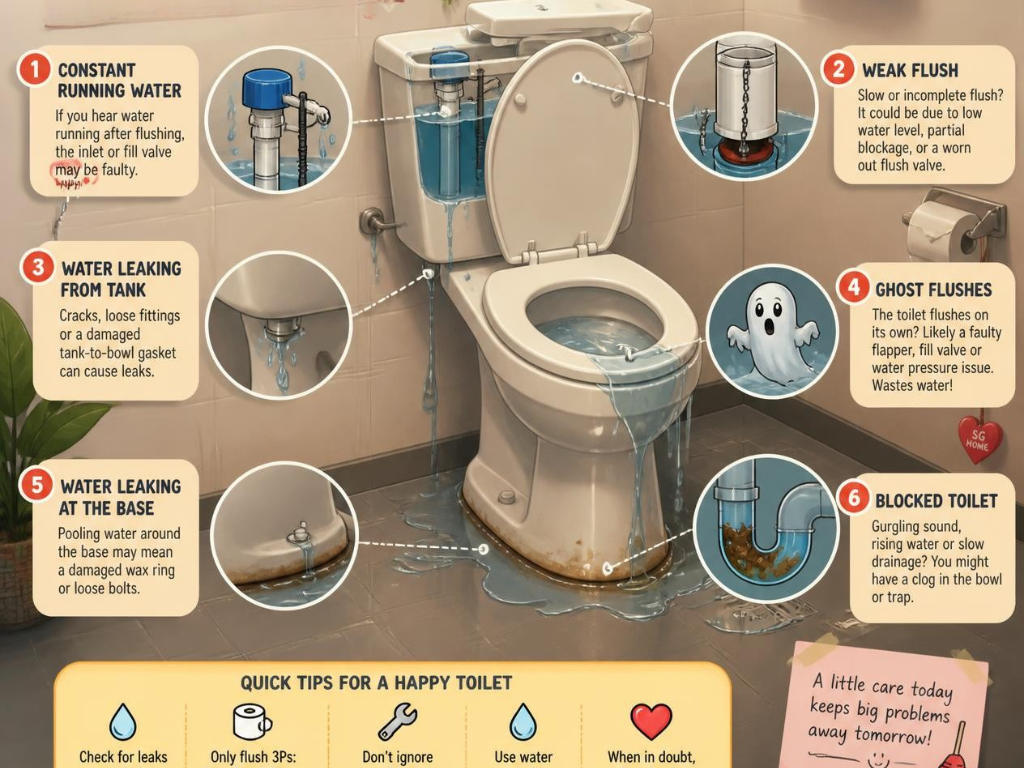

A toilet not flushing properly in Singapore is usually a parts problem, not a plumbing emergency. Singapore Standard SS 636:2018 caps a full flush at 4.5 litres and a reduced flush at 3.0 litres, so a modern cistern has no spare water to hide a fault. This blog walks you through the six real causes, the three tests that separate them, and where residential plumbing repairs start on price.
Why is my toilet flush weak in the first place?
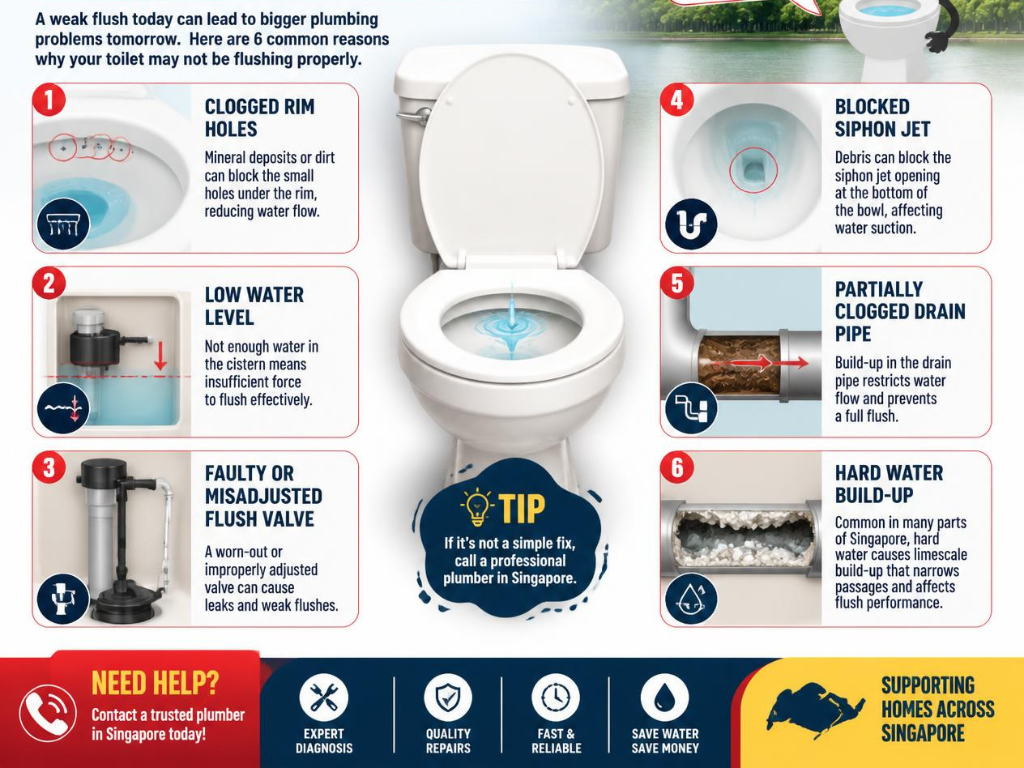
A weak flush comes from one of three places: too little water leaving the cistern, water leaving too slowly, or water leaving fine but arriving badly in the bowl. Everything else is a variation on those three.
The cistern side fails when the water level sits below the marked fill line, when the flush valve seal drops early and cuts the discharge short, or when a worn seal leaks water into the bowl continuously so the cistern never reaches full volume. The bowl side fails when scale blocks the rim jets that wash the bowl walls, or when the siphon jet at the bottom of the bowl silts up and loses the push that starts the siphon.
Age tells you where to look first. In flats under three years old, the fault is almost always a component: a mis-set float, or a flush valve seal that never seated properly after installation. Past the eight-year mark, mineral deposits in the rim jets and siphon jet lead the list.
Worth noting: a genuinely broken flush and a flush that has always felt underwhelming are different problems, and most households conflate them.
How much water should a Singapore toilet actually use per flush?
Full flush is capped at 4.5 litres and reduced flush at 3.0 litres under SS 636:2018, the Singapore Standard governing water services. That is a legal design ceiling, not a target your toilet failed to reach.
PUB’s Mandatory Water Efficiency Labelling Scheme, running since 2009 with a 0 to 3 tick grading, tightened this further. From 1 April 2019, only dual-flush low capacity flushing cisterns rated 2 ticks or above have been allowed for sale and supply in Singapore, and 1-tick fittings were withdrawn from the market entirely on that date. From 1 January 2022, PUB extended the scheme to WC flush valves with “a flush volume of not more than 4.0 litres per flush,” again at a 2-tick minimum.
Run those numbers against what older households remember. A single-flush cistern from the 1990s discharged 9 litres or more. A compliant 3-tick unit today delivers roughly 3.5 litres on full flush, and the bowl clears because the trapway and jet geometry were engineered around that volume.
The practical consequence is a stance most plumbers will not state plainly: if your BTO toilet has felt weak since handover and clears the bowl in one flush, nothing is broken. You are comparing a 3.5 litre flush against a 9 litre memory. Increasing the volume beyond the cistern’s rating puts the fitting outside its WELS registration, which is why we adjust the level to the manufacturer’s line and no higher.
How do you tell a cistern fault from a bowl fault in three tests?
Three checks, in this order, isolate the fault in about ten minutes without tools. Cistern level, dye test, then rim jet inspection.
Start with the water level. Lift the cistern lid and find the moulded fill line or the printed maximum marking on the inside wall. Water sitting more than a centimetre below that line means the fill valve or float needs adjusting, and that single fault explains a large share of weak-flush call-outs.
Next, run the dye test. Drop food colouring into the cistern, wait twenty minutes without flushing, then look in the bowl. Colour in the bowl means the flush valve seal is leaking and the cistern is bleeding volume between flushes, so it never starts a flush at full charge. This is the test that most homeowners skip and it is the one that settles the question.
Last, check the bowl. Hold a small mirror under the rim and look at the jet holes spaced around the underside. Dry patches on the bowl wall during a flush, or a swirl that runs strong on one side and weak on the other, point to blocked rim jets rather than anything in the cistern. Where this breaks down is when two faults stack, which is common past year eight, and the dye test comes back clean while the flush stays weak.
What does the cistern water level have to do with a weak flush?
The water level sets the flush volume directly, because a dual-flush cistern discharges everything above the flush valve seat and nothing below it. Two centimetres of missing water in a 4.5 litre cistern removes a meaningful share of the flush.
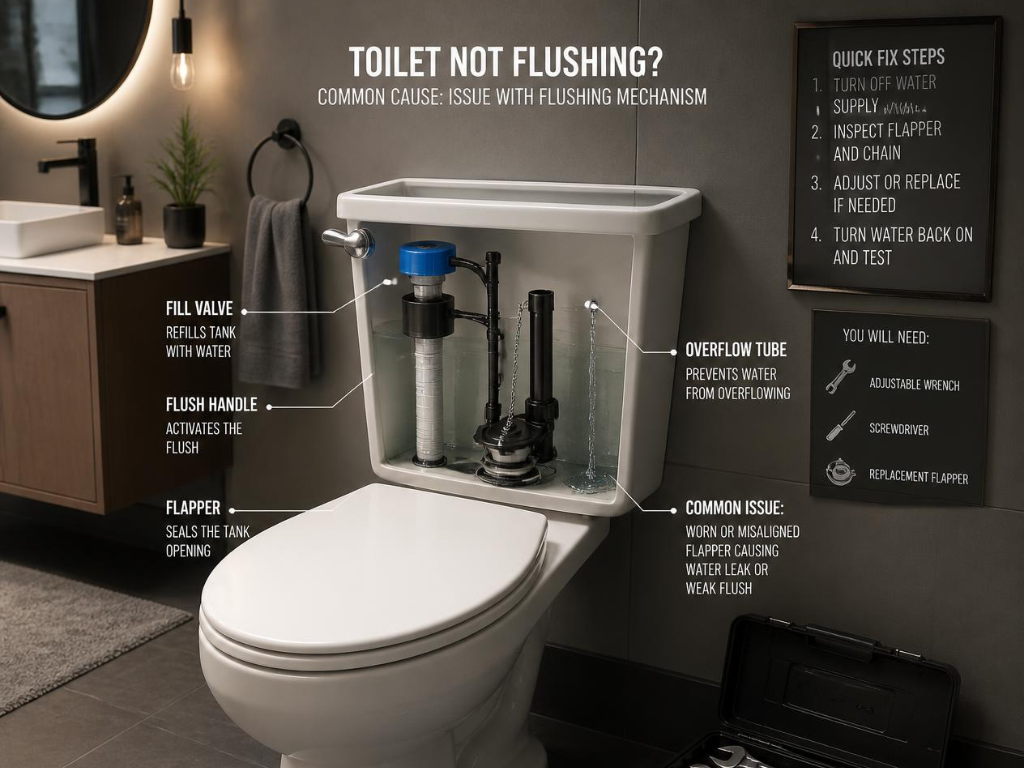
The level is controlled by the fill valve and its float. Older side-entry fill valves use an arm with a ball float, adjusted by bending the arm or turning a screw at the pivot. Modern bottom-entry fill valves, standard in Singapore BTO flats, use a cup float on a vertical stem with a plastic adjustment clip that slides up and down. Raise the float and the valve shuts off later, filling the cistern higher.
Two limits apply. Never raise the level above the manufacturer’s fill line, because water then spills into the overflow tube and runs to the bowl continuously, which shows up as a running toilet and a higher PUB bill rather than a stronger flush. And a fill valve that whistles, refills slowly, or shuts off at a different level each time has failed internally; adjustment will not save it.
In practice, a fill valve is a consumable. Most units in Singapore flats need replacing somewhere between year five and year ten, and a replacement is one of the cheapest interventions in the whole plumbing category.
Why do the rim jets matter more than the water level?
Rim jets distribute the flush around the bowl wall and set up the swirl, so blocked jets waste the water the cistern released. A cistern discharging a perfect 4.5 litres through half-blocked jets still produces a flush that leaves streaks.
Singapore’s treated supply carries dissolved minerals that deposit slowly inside the rim channel, and the rim channel is the one part of a toilet nobody cleans. Deposits build unevenly, which is why a partially blocked bowl flushes hard on one side and barely at all on the other. The tell is a bowl that needs a second flush for solids while the cistern refills at normal speed.
Clearing them is mechanical. A descaling agent poured into the overflow tube reaches the rim channel; stiff wire clears individual jet holes. The siphon jet, the larger opening at the bottom front of the bowl, matters even more, because it triggers the siphon that pulls the contents down. A silted siphon jet produces the classic symptom of water swirling without draining.
Where deposits are hardened and the bowl is past its second decade, replacement beats restoration on cost, and toilet bowl repair and replacement becomes the sensible call rather than another descaling attempt.
Is the flush valve or the fill valve the problem?
The fill valve controls water going into the cistern. The flush valve controls water going out. Symptoms separate them cleanly, and confusing the two is the most common reason households buy the wrong part.
A failing fill valve produces slow refill, a hissing or whistling noise during refill, or a cistern that stops filling below the line. A failing flush valve produces a flush that cuts off early, a cistern that empties slowly into the bowl between uses, or a button that discharges only part of the volume before the seal drops.
The flush valve seal is the single most replaced component in Singapore dual-flush cisterns. It is a rubber ring that hardens and distorts with age, and once it stops seating, the cistern leaks continuously into the bowl. A household with a failed seal loses water around the clock, which is why the dye test is worth running annually rather than only when the flush weakens.
Match the part to the cistern. Geberit, Grohe, Caroma, Baron and TOTO mechanisms are not interchangeable, and the frame stamp inside the cistern or on the concealed access plate carries the model reference you need before buying anything.
Why does a dual-flush button feel weaker than it should?
Dual-flush buttons commonly get pressed wrong, and the smaller button is the reduced flush at 3.0 litres or less. A household using the half flush for everything reports a weak toilet that is behaving exactly as designed.
Beyond user habit, the mechanism itself drifts. Dual-flush buttons operate through push rods or cables that transfer the press down to the flush valve, and those rods slip out of adjustment or shorten in travel over time. A rod set too short lifts the seal only partway, releasing a fraction of the intended volume regardless of which button is pressed. The symptom is a button that feels soft or needs to be held down.
Press-and-hold behaviour is the quick diagnostic here. If holding the full-flush button down produces a noticeably stronger flush than a normal press, the rod travel is short and the mechanism needs adjusting, not the cistern. That single test resolves a large share of the calls we take about weak flushing in flats between three and seven years old.
What is different about a concealed Geberit cistern in a condo?
Concealed cisterns sit inside the wall behind an access panel, so every repair starts with getting the panel off without damaging the tiling. Geberit in-wall frames are standard in Singapore condominiums and in many newer BTO bathrooms, and they change the job rather than the diagnosis.
The mechanics are the same: fill valve, flush valve, water level, seal. Access is not. The service opening sits behind the flush plate, and the plate lifts or unclips depending on the model, with the actuator rods and the service shaft reachable through a rectangular aperture roughly the width of the plate. Working blind through that aperture is what turns a fifteen-minute cistern repair into an hour.
Two things go wrong specifically with concealed units. Flush plate actuators fall out of alignment after careless refitting, producing a soft button and a partial flush. And the service aperture on some installations has been tiled over during renovation, so restoring access requires hacking before any plumbing happens.
Get the model right before ordering parts. Geberit Sigma and Delta flush plates take different actuator assemblies, and the wrong plate does not seat.
When is a weak flush actually a partial choke?
A partial blockage in the trapway or the discharge pipe mimics a weak flush precisely, and the distinguishing sign is the water level in the bowl. A flush that rises high before draining slowly points downstream, not to the cistern.
Run the bucket test to confirm. Pour four to five litres of water straight into the bowl in one go, bypassing the cistern entirely. Clean, fast drainage means the bowl and discharge pipe are clear and the fault sits in the cistern or the rim jets. Water that rises and drains slowly means a partial choke, and no amount of cistern adjustment will fix it.
Partial chokes in Singapore flats usually trace to wet wipes, dental floss and limescale narrowing the trapway. They worsen gradually, which is why households describe a flush that has been weakening for months rather than one that failed. Left alone, a partial choke becomes a full choke.
Clearing a blockage in a water closet sits within PUB’s list of simple plumbing works, so clearing a bowl choke does not require a Licensed Plumber.
Which flush repairs can you legally do yourself in Singapore?
Cistern internals are open scope. PUB’s published list of simple plumbing works permits anyone without a licence to replace “any flushing mechanism” and any flexible hose fitted after the ball valve, alongside clearing blockages in a water closet or floor trap.
The line moves once the work touches the supply installation. Replacing or relocating the toilet bowl itself, altering the water service pipe feeding the cistern, or changing valves on that supply line are regulated water service works. Since 1 April 2018, engaging an unlicensed plumber for regulated works has been an offence, and PUB sets out which plumbing works require a Licensed Plumber in full.
That split explains why a weak flush is one of the few plumbing faults a competent handyman handles end to end, legally. Fix It Papa runs handymen for cistern mechanisms and jet clearing, and PUB-licensed plumbers for bowl replacement and supply pipework, which is why the scope question gets settled on the phone. The HDB plumbing rules for flat owners set out the same boundary for anyone renovating.
One caution. A cistern that is leaking at the tank-to-bowl connection or at the inlet is no longer a mechanism job, because reseating it disturbs the supply connection. Stop and call someone licensed.
What does fixing a weak flush cost in Singapore?
Most weak-flush repairs land at the low end of the plumbing scale, because the parts are inexpensive and the labour is short. Fix It Papa’s published rates start at $80 for a toilet bowl choke, with tap and faucet work from $50.
Costs sort into three tiers. A float adjustment or rim jet descaling is one short visit with no parts. A fill valve or flush valve seal replacement adds a component that runs well under $100 at retail. A concealed Geberit mechanism costs more on both counts, because the part is model-specific and access adds time.
Two variables move the number. After-hours and public holiday attendance carries a surcharge, and our 2026 plumbing rate guide puts that band at $50 to $150 on top of the job. Concealed installations that have been tiled over shift into minor renovation territory, priced separately from the plumbing.
PUB charges no fee for the regulatory submissions a Licensed Plumber lodges, so any submission line on a quotation is that contractor’s own commercial charge. For a job this small, none should appear at all.
The short version
Singapore’s flush volumes are legislated, so the diagnosis is never “add more water.” It is finding which component is losing a share of the 4.5 litres the standard allows. Water level, seal integrity and jet clearance account for nearly all of it, and all three sit inside a handyman’s legal scope, which makes a weak flush one of the cheapest faults in the house to put right.
Run the dye test tonight, then book a free estimate with a photo of your cistern interior and flush plate, so the right part arrives on the first visit.
Frequently asked questions
How do I make my toilet flush stronger?
Raise the cistern water level to the manufacturer’s fill line, then clear the rim jets and siphon jet of mineral deposits. Singapore Standard SS 636:2018 caps full flush at 4.5 litres, so restoring the rated volume and clearing the jets is the ceiling. Higher volumes breach the cistern’s WELS registration.
Why does my new BTO toilet feel weak even though nothing is broken?
Because only 2-tick and 3-tick cisterns have been sold in Singapore since 1 April 2019, and a 3-tick unit uses around 3.5 litres on full flush against the 9 litres older single-flush toilets used. If the bowl clears in one flush, the toilet is performing to its WELS rating.
Can a handyman fix my toilet flush, or do I need a licensed plumber?
A handyman can legally replace the flushing mechanism and clear blockages in a water closet, both listed by PUB as simple plumbing works. Replacing the toilet bowl or altering the supply pipe requires a PUB Licensed Plumber, an offence to hand to anyone unlicensed since 1 April 2018.
How do I know if my flush valve seal is leaking?
Drop food colouring into the cistern and wait twenty minutes without flushing. Colour appearing in the bowl confirms the flush valve seal has failed. The seal is the most replaced part in Singapore dual-flush cisterns and a failed one leaks water continuously, raising your PUB bill.
Is a weak flush the same as a choked toilet?
No. Pour five litres of water directly into the bowl. Fast drainage means the discharge pipe is clear and the fault sits in the cistern or rim jets. Slow drainage with a high water level means a partial choke, which Fix It Papa clears without a Licensed Plumber.
Leave a Reply
You must be logged in to post a comment.