
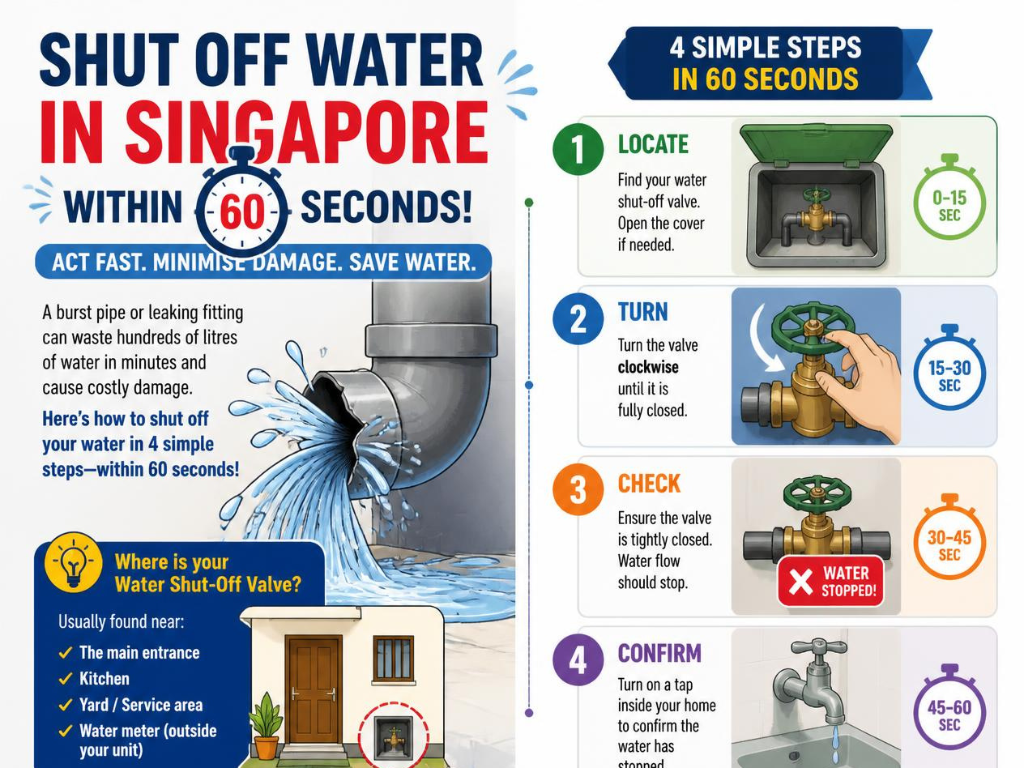

A burst pipe in Singapore costs money by the minute until someone closes a valve. PUB’s 24-hour call centre on 1800-2255-782 handles mains bursts. Everything downstream of your water meter is your bill, under rules PUB last restated in August 2025. This blog walks you through which valve to close, who is legally allowed to repair the pipe, and what emergency plumbing repairs cost.
What should you do first when a pipe bursts in your home?
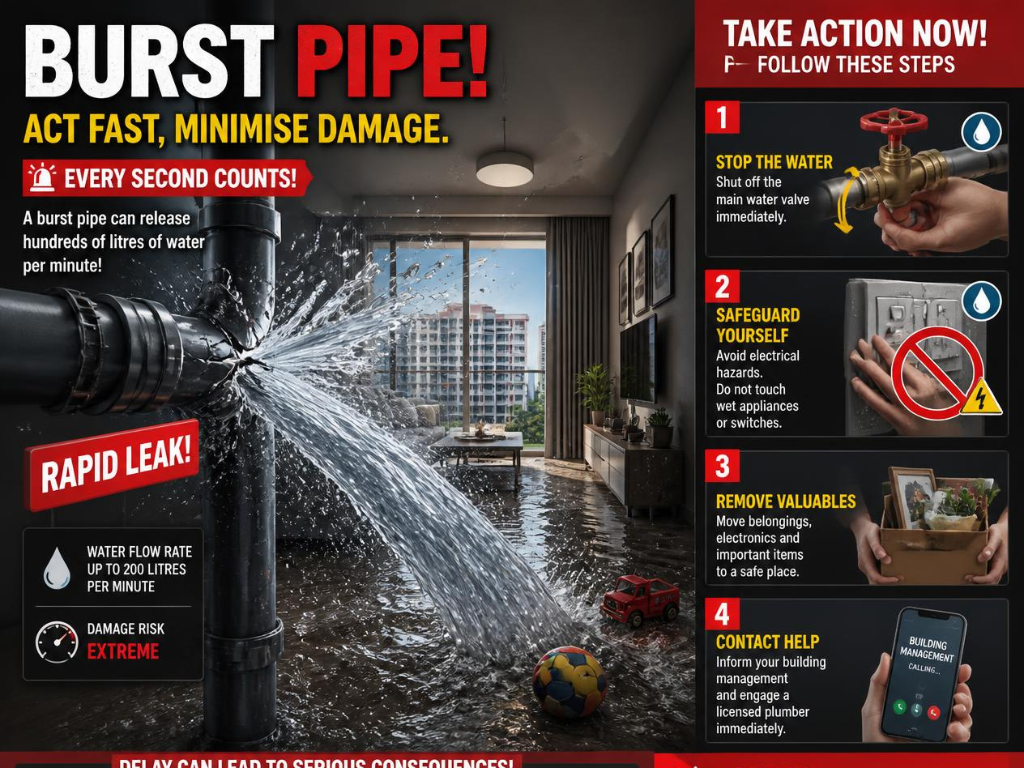
Close the nearest working valve, then the flat’s main stop valve. Do not call anyone until the water stops, because every minute of open flow adds to both your water bill and the repair scope.
A burst pipe is a sudden structural failure in a pressurised water supply line, distinct from a slow leak or a choke. Water arrives under mains pressure, which in Singapore’s high-rise residential blocks typically runs strong enough to soak an adjacent room within minutes. The failure point is usually a joint, a corroded section of concealed pipe, or a flexible hose behind a washing machine or under a sink.
Order matters. Kill the flow at the closest point first, because the valve under your sink is three seconds away and the main stop valve might be outside your front door. Then shut the main. Then cut power to any affected circuit if water has reached a socket or an appliance.
Worth noting: turning a valve is not plumbing work in any regulated sense. You are operating an existing fitting, not altering the installation, so no licence is involved and no rule stops you from doing it at 3am in your pyjamas.
Where is the main water shut-off valve in an HDB flat?
In most HDB flats the main stop valve sits outside the unit, at or beside the water meter, usually in the common corridor near the entrance door or in a riser cupboard on your floor. Older estates place it on an exposed spindle; some blocks group several units’ meters together.
Inside the flat you have a second layer of control. Isolation valves sit under the kitchen sink and the washbasin, behind or beside the toilet bowl feeding the cistern, and on the inlet to a storage or instantaneous water heater. These are the valves that solve most burst-pipe situations without cutting water to the whole home.
The mistake most households make is discovering all of this during the emergency. In practice, the flats that come through a burst pipe with a $200 bill instead of a $2,000 one are the ones where somebody located and turned the main valve six months earlier, confirmed it moves, and told the rest of the household where it is. Test it once a year. A stop valve that has not moved since handover often seizes, and a seized valve during a burst is functionally no valve at all.
Label it. A strip of tape and a marker on the meter housing outperforms any app.
What if the main tap outside your flat has no handle?
Newer HDB blocks fit headless main supply valves, a spindle with no permanent handle, specifically so residents and passers-by cannot casually shut off a unit. Older estates use a square-shaft tap that turns with a standard tap key, clockwise to close.
If your block uses the headless type and you cannot isolate the flat from inside, your fallback is the fixture-level valves plus a call to a plumber who carries the correct key. This is one of the few situations where the difference between a 20-minute response and a 90-minute response shows up directly in the repair invoice, because unchecked flow keeps widening the damage to skirting, cabinet carcasses and the ceiling of the unit below.
Two practical notes from the field. Meter clusters in older blocks are often unlabelled, so confirm which spindle is yours before turning anything, or you will cut your neighbour’s water and still be flooding. And a tap key is a $10 item worth keeping in the same drawer as your torch.
What is different about shutting off water in a condo or landed property?
Condominium units usually have the main stop valve inside the unit, commonly in the yard, a service duct, or an AC ledge cupboard, which makes isolation faster than in an HDB flat. Riser and stack valves belong to the MCST, and only building maintenance may operate them.
Landed properties follow a different pattern again. The meter and main valve sit at the boundary, typically in a ground-level meter chamber near the gate, and the run between that chamber and the house is entirely your responsibility to maintain and repair.
The governance layer changes who you call, not just where you turn. In an HDB block, common-property pipework falls to the town council. In a condo, the same class of problem goes to the managing agent under the MCST. In a landed home, there is no intermediate party at all, which is why landed owners tend to keep a plumber’s number saved and HDB residents tend not to.
Which burst pipe repairs can a handyman legally do, and which need a PUB Licensed Plumber?
Repairing or replacing a water supply pipe is regulated work that requires a PUB Licensed Plumber. Since 1 April 2018, engaging an unlicensed plumber for regulated water service or sanitary plumbing works has been an offence under PUB’s rules.
PUB does publish a defined list of simple plumbing works a handyman may carry out without a licence. On the potable water side that covers replacing or removing a tap or mixer, a shower hose or showerhead, a washing machine or dishwasher connecting hose, a flexible hose, the pipe between a stop valve and an instantaneous water heater, and flushing cistern parts including the flushing mechanism and the flexible hose after the ball valve. On the used water side it covers washbasins and sinks with their bottle traps, bathtubs and shower trays, floor waste outlets, floor trap gratings, and clearing any blockage in a floor trap, water closet or sanitary appliance.
Read that list against a real burst and the boundary becomes obvious. A ruptured flexible hose under the sink is handyman scope, legally and practically. A failed section of concealed copper or PPR in the wall is Licensed Plumber scope, no exceptions, and any contractor who tells you otherwise is exposing you rather than saving you money.
This distinction is the single most useful thing a homeowner can understand before the phone call, because it determines who can legitimately quote for the job. Fix It Papa runs both capabilities under one roof, with handymen for simple works and PUB-licensed plumbers for regulated works, which is why the triage happens on the phone rather than after a wasted call-out.
You can verify any plumber’s licence yourself on PUB’s online Licensed Plumber register before work begins.
Is the burst pipe your problem or PUB’s?
The water meter is the dividing line. PUB owns and maintains the supply main up to the meter; everything after the meter, inside your premises, belongs to the property owner.
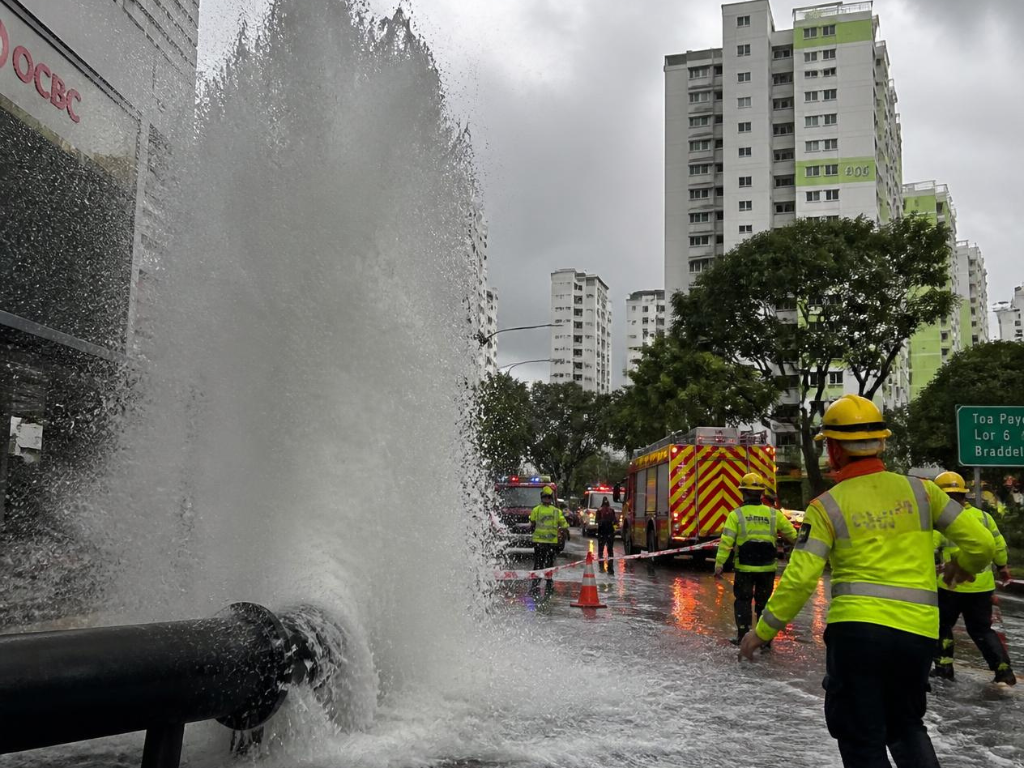
This is why a dramatic street-level burst and a soaked kitchen cabinet produce completely different phone calls. When workers struck a 300mm potable water main near Still Road South in October 2024, flooding roads and common areas around Marine Drive, PUB deployed a crew to isolate and repair it. No resident paid for that pipe. A failed joint under your own sink sits on the other side of the meter, and no agency is coming.
Call PUB’s 24-hour line on 1800-2255-782 for mains bursts, water interruptions and pressure problems. Call SP Group on 1800-222-2333 for anything about the water account and billing itself. For a burst inside the unit, neither call fixes the water on your floor.
Does your insurance cover a burst pipe in Singapore?
Home contents insurance generally covers the water damage. It does not cover the pipe. That distinction catches out most households at claim time.
HDB Fire Insurance, administered by Etiqa Insurance since 16 August 2024, covers the internal structure, fixtures and fittings supplied by HDB at handover. It does not extend to your renovations, your built-ins, or your contents. For a flat with a renovated kitchen, that is precisely the part a burst pipe destroys.
Private home contents policies fill the gap, with a specific carve-out worth reading. Income’s Enhanced Home Insurance covers building, renovations and contents damaged by bursting water pipes or tanks, while excluding damage to the pipes and tanks themselves and “the expenses to trace any leakage.” Policies also separate sudden bursts from gradual seepage; the second is treated as a maintenance issue and typically falls outside cover.
The practical consequence is direct. Insurance may rebuild your cabinetry, but you pay for the leak detection and the pipe repair, and you pay more of both the longer the water runs. Speed of shut-off is the variable you control. Photograph everything before you clear up, because the claim depends on evidence you can only capture once.
What does emergency burst pipe repair cost in Singapore?
Expect a call-out plus labour plus materials, with a surcharge for after-hours attendance. Fix It Papa’s published rates start at $50 for tap and faucet repair, $80 for a toilet bowl choke, and $120 for water heater installation, with typical after-hours and public holiday surcharges running $50 to $150 on top.
Concealed pipe work prices differently, because hacking, reinstatement and tiling are quoted separately from the plumbing itself. A visible burst on an exposed pipe run is a contained job. The same failure behind a wall becomes a repair plus a small renovation, which is the honest reason quotes for “a burst pipe” range so widely.
PUB charges no administrative or processing fee for the regulatory submissions a Licensed Plumber lodges, so any submission fee on your invoice is a commercial charge set by that plumber, not a government levy. PUB’s own guidance to homeowners is to discuss scope and cost before engagement, request itemised quotations, and “obtain at least three quotes for comparison.”
Three quotes is sound advice for a planned job. It is unrealistic at 2am with water running, which is the argument for identifying a plumber you trust while nothing is wrong. Compare our 24-hour emergency call-out terms against two others now, and the 2am decision is already made.
How do you stop a burst pipe from damaging the unit below?
Shut the water, then contain what has already escaped, because water on a high-rise floor slab migrates toward service penetrations and reaches the ceiling below faster than most people expect. Towels along the doorway threshold and around floor traps buy time.
Notify the unit below early, ideally before they notice a stain. Water damage between neighbouring units is one of the more common sources of dispute in Singapore’s high-rise housing, and disputes escalate on perceived concealment rather than on the damage itself. A message within the hour, with photos and a plumber already on the way, changes the entire conversation.
Keep the paper trail. Log the time you discovered the burst, the time you closed the valve, and the plumber’s arrival time. If a liability question arises later between you, your neighbour, the town council or the MCST, that timeline is the evidence that establishes you acted promptly.
How can you keep a pipe from bursting in the first place?
Replace flexible hoses on a schedule rather than on failure. Braided flexible hoses feeding taps, washing machines and cisterns are the most common burst point in Singapore homes, they are consumables, and they are cheap to change before they fail.
Corroded concealed pipework is the slower risk, and it announces itself. Dropping water pressure, rust-tinged water after a period of non-use, and recurring damp patches on a wall all indicate a supply line degrading behind the plaster. Those symptoms warrant concealed leak detection rather than a wait-and-see approach, because the repair cost climbs steeply once the failure is sudden rather than scheduled.
Storage water heaters deserve their own attention. A leaking heater tank floods a bathroom and carries an electrical risk at the same time, so the inlet valve position matters as much as the isolation valve, and annual water heater servicing catches tank corrosion before it opens. Keep the same discipline for floor traps, since a blocked trap turns a modest leak into a flooded floor; that clearing work sits in PUB’s simple works list and a blocked floor trap does not require a Licensed Plumber.
The 60-second version
The pipe on your side of the water meter is your responsibility, your bill, and largely your insurance excess. What determines the size of that bill is not the burst itself but how many minutes pass before someone closes a valve, and whether the person you call afterwards holds the licence the job legally requires. Both are decided long before the pipe fails.
Locate your main stop valve this week, turn it once to confirm it moves, and save a plumber’s number that covers both handyman and PUB-licensed work. Request a free estimate from Fix It Papa and get the valve location confirmed during the visit, so the 2am version of this problem takes 60 seconds instead of an hour.
Frequently asked questions
Can I turn off my own water supply, or do I need a licensed plumber?
You can turn it off yourself. Operating an existing stop valve is not regulated plumbing work under PUB rules, so no licence applies. The licence requirement starts when a pipe, tank, tap fitting or sanitary appliance is altered, repaired or replaced, which has been an offence to hand to an unlicensed plumber since 1 April 2018.
Who do I call at 3am for a burst pipe in an HDB flat?
Call a 24-hour plumber for anything inside your flat, since PUB’s responsibility ends at the water meter. Use PUB’s 24-hour line on 1800-2255-782 only for mains bursts, water interruptions or pressure problems affecting the block. Fix It Papa dispatches across Singapore round the clock.
Does HDB Fire Insurance cover a burst pipe?
It covers damage to the internal structure, fixtures and fittings originally provided by HDB. Etiqa Insurance has administered the scheme since 16 August 2024. Renovations, built-in carpentry, furniture and personal contents are excluded, so a renovated flat needs a separate home contents policy for meaningful burst-pipe protection.
How much does an after-hours plumber cost in Singapore?
Budget the standard job rate plus $50 to $150 for after-hours or public holiday attendance. Fix It Papa’s rates start at $50 for tap repair and $80 for a toilet bowl choke. Concealed pipe repairs quote separately, because hacking, reinstatement and tiling are priced apart from the plumbing.
Is my tap water safe after a burst pipe is repaired?
Run the taps for several minutes after supply is restored to flush sediment disturbed during the repair. Discoloured water usually clears within minutes. If it persists, report it to PUB’s 24-hour call centre on 1800-2255-782, which handles water quality alongside supply interruptions.
Leave a Reply
You must be logged in to post a comment.