
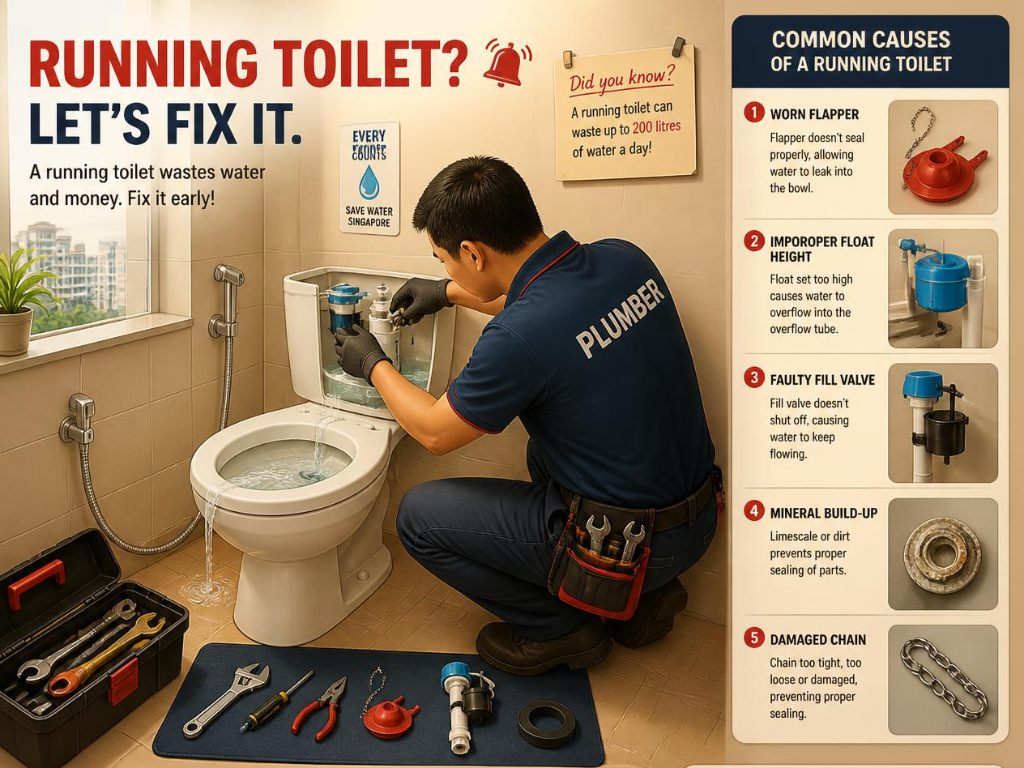

A toilet that keeps running in Singapore is the country’s most expensive small fault. PUB’s smart water meter pilots across 800 households found roughly 10 per cent had leaks, mostly at the cistern. This blog walks you through which of the two valves is failing, how to confirm it in ten minutes, and what the leak adds to your bill before you call for household plumbing repairs.
Why does my toilet keep running after I flush?
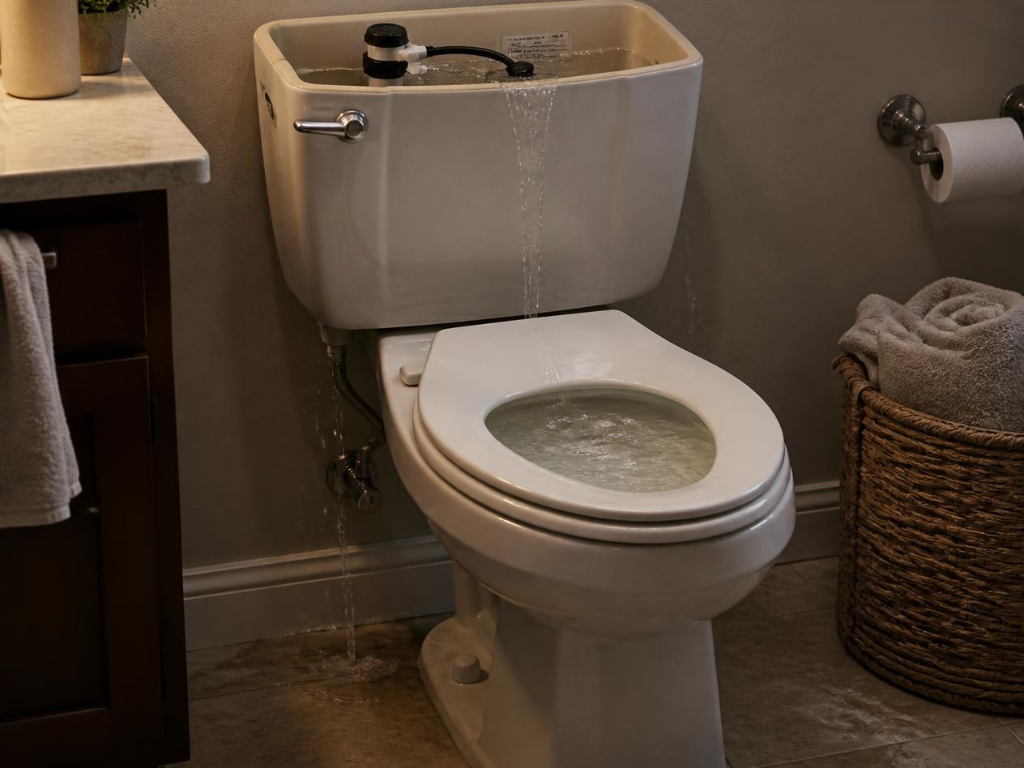
Water is escaping the cistern faster than the fill valve can shut off, and it takes one of two routes. Either it leaks down through the flush valve into the bowl, or it rises past the fill line and spills into the overflow tube.
Those two routes explain nearly every running toilet. The flush valve route is the quiet one, because water slips past a worn cartridge seal and slides down the back of the bowl without noise. The overflow route is the loud one, because the fill valve never reaches its shut-off point and runs continuously into the standpipe at the centre of the cistern.
A third cause sits behind both. The fill valve itself wears out and stops sealing, so it keeps admitting water regardless of level. That failure produces a hiss you can hear from the doorway at night.
In practice, the age of the flat sorts these quickly. Cisterns under five years old that start running have almost always developed a cartridge seal fault. Past ten years, the fill valve diaphragm is the more likely culprit, and by then both parts are usually due together.
Is the flush valve or the fill valve causing it?
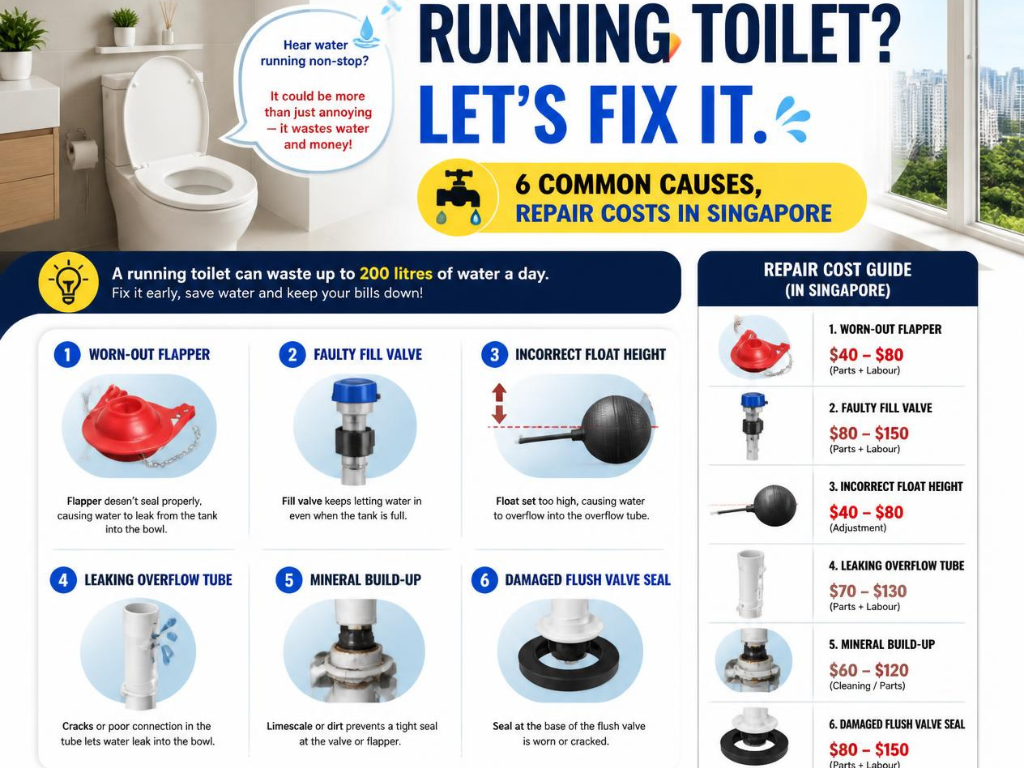
The flush valve controls water leaving the cistern into the bowl. The fill valve controls water entering the cistern from the supply. Where the water ends up tells you which one failed.
Water appearing in the bowl with the cistern level sitting normal at the fill line means the flush valve cartridge seal is passing. Water reaching the top of the overflow tube and disappearing down it means the fill valve is not shutting off and the level has overshot. Look at the level first, because that single observation splits the diagnosis before you touch anything.
Float height sits between the two. Modern Singapore cisterns use a cup float riding on a vertical stem with a sliding adjustment clip, and a clip that has crept upward raises the shut-off point until water clears the overflow rim. Adjustment fixes that in under a minute. A fill valve that hisses, refills unevenly, or shuts off at a different level on each cycle has failed internally, and no adjustment recovers it.
Both parts are consumables rather than lifetime fittings. Most units in Singapore flats want replacing somewhere between year five and year ten, and replacing both together on the same visit costs less in labour than two separate call-outs.
Why doesn’t my Singapore toilet have a flapper and chain?
Because Singapore mandates dual-flush cisterns, and dual-flush designs do not use a flapper on a chain. Singapore Standard SS 636:2018 requires every flushing cistern serving a water closet to deliver two flush volumes, with a full flush not exceeding 4.5 litres and a reduced flush not exceeding 3.0 litres.
That single requirement rules out the flapper. A flapper is a hinged rubber flap lifted by a chain from a trip lever, and it delivers one volume, all of it. Singapore cisterns instead use a drop valve cartridge, a vertical assembly with a rubber seal at its base that lifts on push rods from the flush plate and drops back when the water reaches a set point. There is no chain to shorten, no chain to tangle, and no flapper to warp.
This matters more than it sounds. Most of the search results for a running toilet come from the United States, where flapper-and-chain single-flush toilets remain standard, and the standard advice is to shorten the chain or replace the flapper. Following that guidance in an HDB flat produces nothing, because neither part is present.
The equivalent failure in a Singapore cistern is the cartridge seal, a rubber ring at the base of the drop valve. It hardens with age, stops seating flush against the valve seat, and passes water continuously into the bowl. Take the stance plainly: if a guide tells you to adjust the chain, it was not written for your toilet.
How do I confirm a silent cistern leak in ten minutes?
Run the dye test. Drop food colouring into the cistern, leave it twenty minutes without flushing, then look into the bowl. Colour in the bowl confirms the cartridge seal is passing water.
The test works because a silent leak has no other tell. A cartridge seal that has just started to fail passes water slowly enough to produce no sound, no visible trickle and no change in the cistern level, since the fill valve tops up as fast as the water escapes. Households in this state lose water around the clock for months without noticing.
Two checks sharpen the result. Wipe the back wall of the bowl dry before you start, so any coloured streak that appears is unambiguous. And do not flush during the twenty minutes, because a single flush voids the test entirely.
A clean dye test with a running noise still present moves the diagnosis to the fill valve. Check the overflow tube next: water flowing over its rim means the level has overshot and the shut-off has failed.
Worth noting: run this test annually rather than only when you suspect something. The seal that fails silently is the one that costs the most, precisely because nobody investigates a toilet that appears to work.
Can my PUB smart water meter tell me the toilet is leaking?
Yes, and it is the most reliable detection method available to Singapore households. PUB’s Smart Water Meter Programme sends registered users “notifications on suspected leaks, abnormal or high consumption” through the MySmartWaterMeter portal.
The hourly data is the part most households never use. MySmartWaterMeter shows consumption in hourly intervals for the previous day, daily intervals for the past seven days and the current month, and monthly intervals for the past twelve months, refreshed once daily. Open the hourly view and look at the overnight block between roughly 1am and 5am, when nobody in the flat is using water. A household with no leak reads zero across those hours. A household with a running toilet reads a steady non-zero baseline that never drops.
That baseline is the leak, quantified. It converts a suspicion into a litres-per-hour figure you can hand to a plumber, and it distinguishes a cistern leak from a concealed pipe leak by whether the flow stops when you close the cistern’s isolation valve.
The first phase of the programme covered 300,000 meters installed by SP Services under the Smart PUB Roadmap, so coverage varies by estate. Households without a smart meter fall back to the manual equivalent: read the meter last thing at night, use no water, read it again at dawn, and any movement is a leak.
What is a running toilet costing me each month?
Water in Singapore costs $3.24 per cubic metre before GST for households under 40 cubic metres a month, or roughly $3.53 with 9 per cent GST added. One cubic metre is 1,000 litres, which makes the arithmetic on a leak straightforward.
Work it from the hourly figure. A slow cartridge seal leak passing one litre an hour loses 24 litres a day and about 720 litres a month, which is roughly $2.50 on the bill. A moderate leak at 10 litres an hour reaches 7,200 litres a month, near 7.2 cubic metres, and costs about $25 monthly. A fill valve running continuously over the overflow tube moves well past that, because a fill valve is designed to refill a 4.5 litre cistern in under a minute.
Those numbers sit against a rising baseline. PUB raised the water price by 50 cents per cubic metre in two phases, 20 cents from 1 April 2024 and a further 30 cents from 1 April 2025, taking a cubic metre from $2.74 to $3.24 before GST. The same leak costs 18 per cent more today than it did in early 2024.
The repair almost always costs less than a quarter of leaking. That is the argument for treating a running toilet as urgent rather than cosmetic, and it is why PUB’s pilot households achieved around 5 per cent average water savings simply from early leak detection.
Why does my toilet run for a few seconds on its own?
That is a phantom flush, and it means the cartridge seal is leaking slowly rather than steadily. Water escapes into the bowl until the cistern level drops far enough to trip the fill valve, which then refills for a few seconds and stops.
The interval tells you the severity. A cistern that refills every ten minutes is losing water fast enough to justify same-day attention. One that refills twice a night is at the early stage of the same failure, and the seal will keep degrading from there.
Households often blame a pressure fluctuation in the block. A sealed cistern with a working valve holds its level indefinitely, so any unprompted refill means water left the tank.
Descaling sometimes buys time. Mineral deposits on the valve seat prevent the seal from seating flush, and cleaning the seat restores contact on a seal that has not yet hardened. Where the rubber has gone stiff and shiny, replacement is the only fix, and the cartridge is a low-cost part.
Why does a push-button dual-flush cistern keep running?
Push rods hold the drop valve open. On a dual-flush cistern the flush plate operates two rods, and a rod that stays depressed keeps the valve lifted so water runs without stopping.
Rods jam for mundane reasons. The flush plate gets refitted crooked after cleaning, a rod binds against the frame, or the button sticks in the pressed position. A button that feels soft, stays flush with the plate, or has to be pulled back out points straight at the actuator rather than the cistern internals.
Test it by lifting the flush plate off. If the running stops the moment the plate comes away, the actuator is the fault and the cistern is fine. If water keeps running with the plate removed, the problem is the cartridge or the fill valve underneath.
Concealed cisterns complicate this. Geberit in-wall frames, standard across Singapore condominiums and many newer BTO bathrooms, put the whole assembly behind a wall panel, so the same five-minute check needs the flush plate off and the service aperture clear. Geberit Sigma and Delta plates take different actuator assemblies, and the wrong replacement does not seat.
Can I fix a running toilet myself under PUB rules?
Cistern internals are open scope. PUB’s published list of simple plumbing works permits anyone without a licence to replace “any flushing mechanism” along with any flexible hose fitted after the ball valve, which covers the cartridge, the seal and the fill valve.
The boundary sits at the supply connection. Replacing or relocating the toilet bowl, altering the water service pipe feeding the cistern, or changing the isolation valve on that supply line are regulated water service works requiring a PUB Licensed Plumber, and since 1 April 2018 engaging an unlicensed plumber for regulated works has been an offence. PUB sets out which works need a Licensed Plumber in full, and the same split governs what HDB flat owners can fix during renovation.
A running toilet therefore sits almost entirely inside handyman territory, which is unusual for a plumbing fault and worth knowing before anyone quotes you licensed rates for a cartridge swap.
Match the part before buying. Geberit, Grohe, Caroma, Baron and TOTO cartridges are not interchangeable, and the model reference is stamped inside the cistern or on the concealed frame. Where the leak is at the tank-to-bowl joint rather than inside the cistern, stop, because reseating that connection disturbs the supply and shifts the job into cistern and bowl servicing.
What does a running toilet repair cost in Singapore?
Most running toilet repairs are a short visit plus a low-cost part. Fix It Papa’s published plumbing rates start at $50 for tap and faucet work, with toilet bowl choke clearing from $80.
Three tiers cover almost every case. A float adjustment or valve seat descaling needs no parts at all. A cartridge seal or fill valve replacement adds a component that typically runs under $50 at retail for exposed cisterns. A concealed Geberit mechanism costs more on both the part and the labour, because the assembly is model-specific and working through the service aperture adds time.
Two things move the figure. After-hours and public holiday attendance carries a surcharge, and our current plumbing rate bands put that at $50 to $150 on top of the job. A concealed cistern whose access panel was tiled over during renovation shifts into minor renovation, quoted separately.
Where the dye test comes back clean and the meter still shows overnight flow, the leak is not the toilet, and hidden leak detection becomes the right service rather than another cistern part.
The short version
A running toilet in Singapore is a two-valve problem with a cartridge seal at the centre of it, and the reason it goes unfixed is that the worst version makes no sound at all. PUB’s own pilot data puts the cistern at the top of the household leak list, water now costs $3.24 per cubic metre before GST, and the part that fixes it costs less than a month of leaking.
Run the dye test tonight, check your overnight hourly reading on MySmartWaterMeter, then get a free estimate with the cistern model reference to hand so the correct cartridge arrives on the first visit.
Frequently asked questions
How do I stop a toilet from running temporarily?
Close the isolation valve on the supply pipe beside or behind the toilet, turning it clockwise. The cistern stops refilling and the leak stops with it, though the bowl will not flush until you reopen it. Operating an existing valve is not regulated work under PUB rules, so no licence applies.
Why is my toilet tank not filling but water is still running?
The fill valve has failed and water is passing straight into the overflow tube instead of holding in the cistern. Check whether the level sits at the overflow rim. Fix It Papa treats this as a fill valve replacement, a part that typically runs under $50 for exposed Singapore cisterns.
Will a running toilet fix itself?
No. A cartridge seal hardens progressively and a fill valve diaphragm wears in one direction only, so the leak grows. At 10 litres an hour a running toilet adds roughly $25 a month at Singapore’s 2026 rate of $3.53 per cubic metre including GST.
Does a running toilet count as a leak PUB will notify me about?
Yes, if your premises has a smart water meter. MySmartWaterMeter sends alerts for suspected leaks and abnormal consumption, and PUB’s pilot trials across 800 households found cisterns were the most common leak location. Households without a smart meter must check the meter manually overnight.
Can a handyman replace my flush cartridge, or do I need a licensed plumber?
A handyman can legally do it. PUB lists replacing any flushing mechanism among the simple plumbing works permitted without a licence. Replacing the toilet bowl or altering the supply pipe requires a PUB Licensed Plumber, an offence to hand to anyone unlicensed since 1 April 2018.
Leave a Reply
You must be logged in to post a comment.