
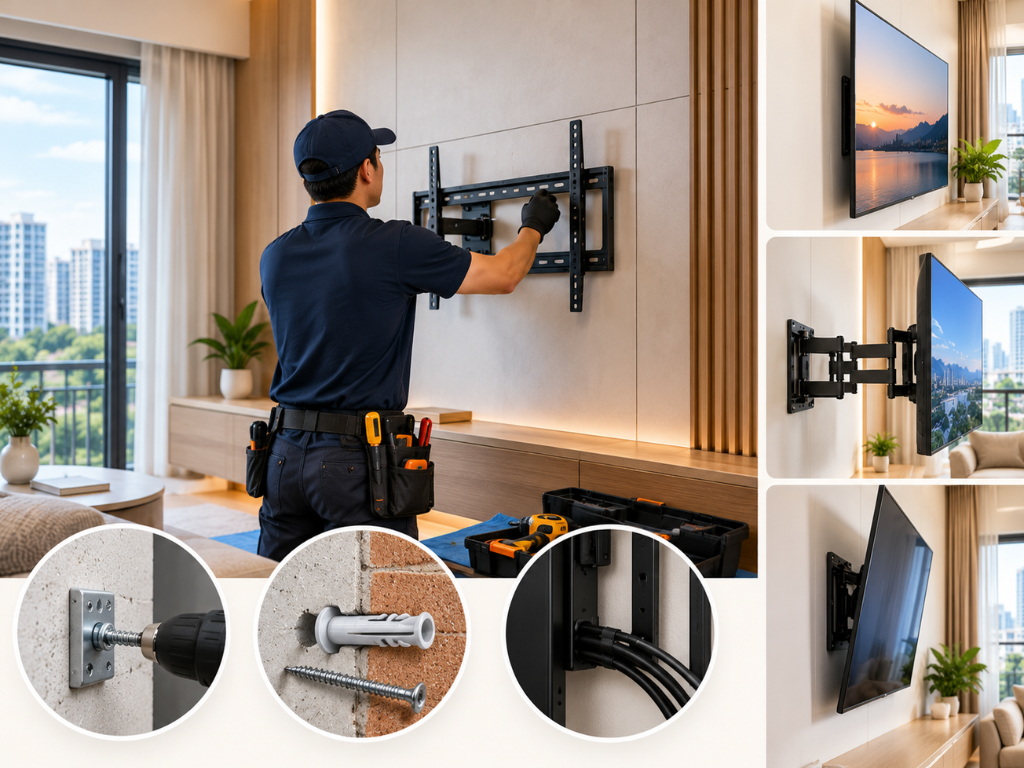

TV wall mount installation in Singapore costs $60 to $100 in labour at Fix It Papa’s 2026 rates, or $120 to $180 with the bracket supplied. The anchor matters more than the price: US CPSC data shows 47% of reported tip-over deaths from 2013 to mid-2023 involved a television. This blog walks you through cost, brackets, wall types, and when to book handyman mounting and installation services.
How much does a TV mounting service cost in Singapore in 2026?
A standard TV mounting service costs $60 to $100 for labour on a bracket you already own, or $120 to $180 if Fix It Papa supplies and installs the bracket. The bracket type sets where in that range a job lands.
| Mounting job | Fix It Papa 2026 rate |
| TV wall mounting, labour only | $60 to $100 |
| TV bracket supply and install | $120 to $180 |
| Pictures or mirrors, first 3 items | $50 to $80 |
| Curtains or blinds, per window | $50 to $80 |
| Towel rack or grab bar | $60 to $90 |
| Drilling only, per hole | $10 to $20 (minimum charge applies) |
Two fixed costs sit around those rates. The $50 to $60 call-out fee is often waived once the job is confirmed, and a $50 to $80 minimum labour charge applies to any visit under an hour.
Some setups fall outside the standard range and are priced from photos. A full-motion arm on a drywall partition needs a backing plate. Cable concealment inside a partition adds time, and a power point move needs a licensed electrician on a separate booking.
The cleaner approach is to price the whole wall at once. A TV, a soundbar shelf and a router shelf share one drill setup and one call-out. Fix It Papa’s 2026 handyman price guide lists the rates for anything else on the list.
Which TV bracket should you choose: fixed, tilt or full-motion?
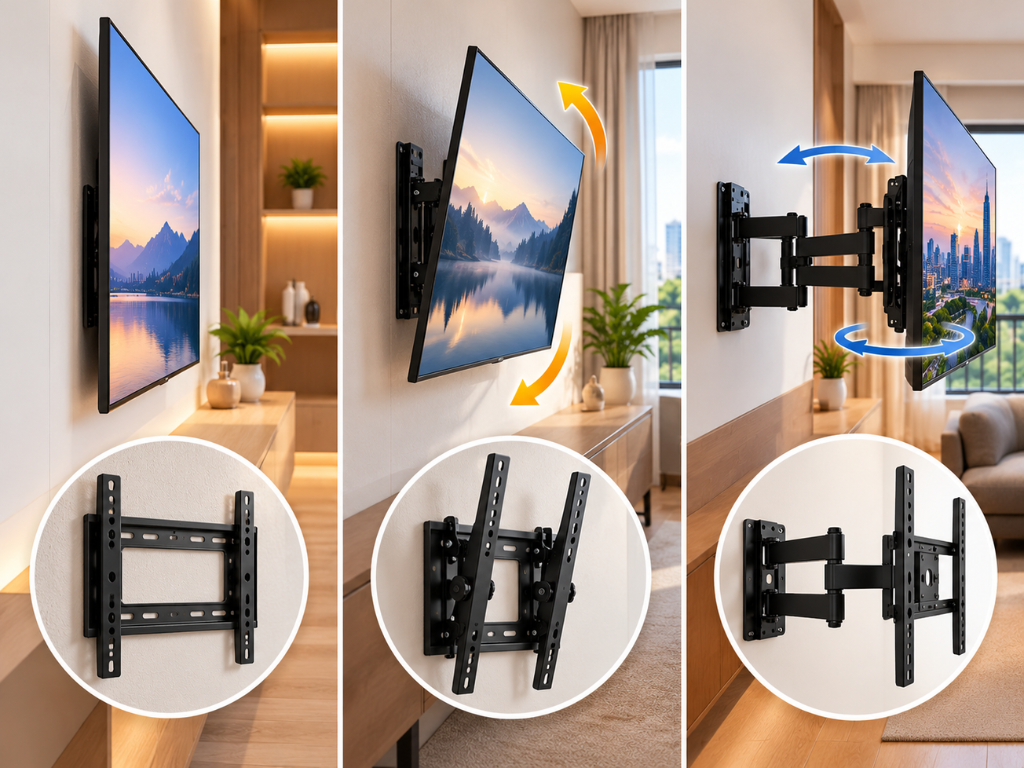
Choose a fixed bracket for most HDB living rooms, where the sofa faces the TV square on. It sits closest to the wall, has the fewest moving parts, and puts the least strain on the anchors.
A tilt bracket angles the screen downward, typically by 5 to 15 degrees. It suits a TV mounted above a tall console or a bedroom TV watched from a low bed. It sits slightly further off the wall than a fixed bracket.
A full-motion arm extends the TV out from the wall, often 40 to 70cm, and swivels. It earns its place in a corner, an open kitchen-living layout, or a room where seating changes. Where this breaks down is the pull on the wall. The further the TV sits from the wall, the harder it pulls on the top anchors. A full-motion arm therefore needs a stronger fixing than a fixed bracket carrying the same TV.
If the viewing position never changes, a full-motion arm adds risk without adding anything to the picture. A fixed or tilt bracket gives the same view with a simpler, stronger install.
Worth noting: a soundbar rarely attaches to the TV bracket. Plan a separate shelf or soundbar bracket before drilling, so the two line up.
How do you match the VESA pattern and the bracket’s load rating?
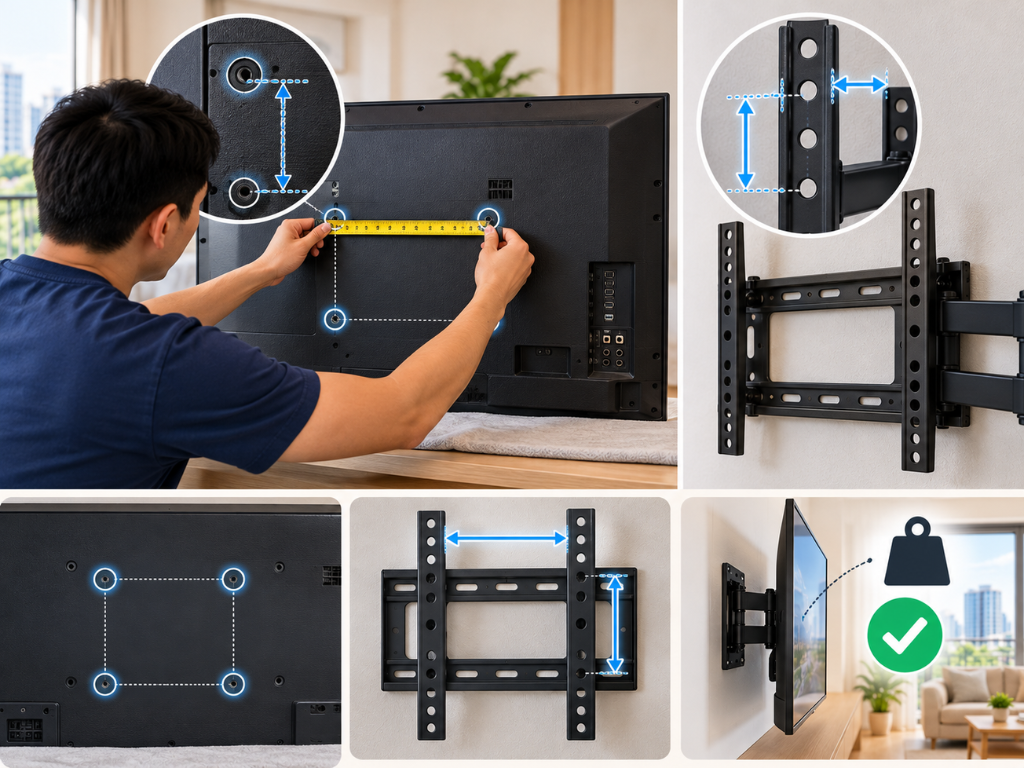
Match the four-hole VESA pattern on the back of the TV to a bracket that lists that exact pattern, then check the bracket’s weight rating against the TV. Both numbers are on the TV’s spec sheet and the bracket box.
VESA patterns are written as horizontal by vertical hole spacing in millimetres, such as 200×200, 300×300 or 400×400. A bracket rated for 400×400 also covers smaller patterns if its plate has those hole positions. It will not fit a 600×400 TV, because the outer holes do not line up.
Fix It Papa’s rule on load is a 1.5x margin. A TV weighing 20kg without its stand needs a bracket rated for at least 30kg. Most 65-inch TVs weigh roughly 18 to 30kg without the stand, so check the model, not the screen size.
Screws matter as much as the plate. TV mounting holes commonly take M6 or M8 bolts, and a bolt that is too long bottoms out inside the chassis while one that is too short barely grips. Use the spacers in the bracket kit when the back of the TV is curved or has a recess.
Which wall anchor suits your HDB or condo wall?
The wall decides the anchor. Reinforced concrete takes masonry anchors drilled with a hammer drill. Drywall partitions need the bracket fixed into metal studs or a backing plate. Lightweight block and tiled walls each need their own fixing and drilling method.
Concrete is the strongest and most common HDB living-room wall. Sleeve or wedge anchors sized to the bracket hold a fixed-bracket TV with a wide margin. Full-motion arms on large screens call for heavier anchors spaced as wide as the bracket allows.
Drywall partitions, common in condo bedrooms and some newer flats, cannot hold a TV bracket on the board alone. The bracket has to land on metal studs, which typically sit 400 to 600mm apart. If the bracket’s holes cannot reach two studs, a timber or steel backing plate goes across the studs first and the bracket fixes to that.
Tiled feature walls need a tile bit and slow, non-hammer drilling until the bit is through the glaze. A cracked tile behind a TV is rarely an easy match to replace.
Can you mount a TV on a drywall partition or a tiled feature wall?
Yes to both, with the right method. A drywall partition takes a TV when the bracket fixes into the studs or a backing plate. A tiled wall takes one when the holes go through the tile without cracking it.
The partition case trips up the most installs. A plastic plug in plain gypsum board feels firm on the day and works loose under the steady pull of a TV over the following weeks. Full-motion arms on partitions are the highest-risk combination, because every swing loads the top fixings.
Condo feature walls add another layer. Timber or panel cladding over the structural wall hides what is behind it, so the fixing has to pass through the panel into the wall or a frame behind. Check with your MCST before drilling a feature wall in a common-design unit, since some condos restrict works on certain walls.
Where you cannot tell the wall type from a tap test, a stud finder and a small pilot hole settle it. That 10-minute check costs far less than a TV on the floor.
How do you hide TV cables without damaging the wall?
Use surface trunking on concrete walls and in-wall routing only on drywall partitions. Any change to a power point is electrical work for a Licensed Electrical Worker, not part of a mounting job.
Surface trunking is the default for HDB concrete walls. A slim PVC channel, painted to match the wall, runs from the TV down to the console and hides HDMI and power cables without cutting into the wall.
Drywall partitions allow a tidier finish. Cables pass through a hole behind the TV, down the cavity, and out behind the console. Power is the limit. Running an extension cord inside the wall is not a safe substitute for a proper power point.
Moving or adding a power point behind the TV is electrical installation work. The Energy Market Authority requires electrical work in homes to be done by a Licensed Electrical Worker. Fix It Papa handles that through its licensed electrical works team as a separate booking.
Chasing a channel into a concrete wall to bury cables is renovation-scale work. It belongs in a renovation plan, not a TV mounting visit.
When can a handyman drill for a TV mount in an HDB flat?
Book the mount on a weekday between 9am and 5pm if it needs heavy drilling into concrete. HDB’s renovation rules allow general works from 9am to 6pm on weekdays and Saturdays, and restrict heavy drilling to 9am to 5pm on weekdays.
Works are barred on Sundays and public holidays. Restricted works are also barred on the eves of New Year’s Day, Chinese New Year, Deepavali, Hari Raya Puasa and Christmas Day.
A single TV bracket needs four to six holes. A full wall setup with a TV, a soundbar bracket, two floating shelves and trunking involves far more drilling, so it belongs in a weekday slot.
Condos set their own contractor hours through each MCST, often tighter than HDB’s. Check the management office’s renovation hours before booking a Saturday.
Is a wall-mounted TV safer than one on a console?
Yes, when it is mounted correctly. A TV fixed to the wall cannot tip forward, and tip-overs are where TVs cause the most serious injuries. Of 217 tip-over deaths reported to the US Consumer Product Safety Commission from 2013 to July 2023, 47% involved a television.
The same February 2024 report estimated 17,800 emergency-department injuries a year from TV, furniture and appliance tip-overs, with children under 18 taking 44% of them. “Furniture and TV tip-overs remain a significant safety hazard in American households,” said CPSC Chair Alex Hoehn-Saric.
CPSC’s own advice is to anchor TVs and furniture to the wall. Where that is not possible, it recommends a sturdy, low base with the TV pushed back and cables out of reach.
The safety benefit depends on the install. A bracket on the wrong anchor moves the risk from tipping forward to pulling out of the wall. That is why the anchor-to-wall match matters more than the bracket brand.
What else can the same visit mount?
The same visit can mount anything that uses the same drill and wall: a soundbar bracket, floating shelves, mirrors, curtain tracks, picture frames and bathroom accessories. Grouping them saves a second call-out and a second minimum labour charge.
Shelves under a TV are the most common add-on. They carry routers, set-top boxes and consoles, and they need the same anchor-to-wall match as the TV bracket. Mirrors over 10kg need fixings rated for their weight, not adhesive pads.
Curtain tracks and towel racks often sit on the same move-in list. Fix It Papa’s 2026 rates put curtains at $50 to $80 per window and towel racks at $60 to $90. A TV mount, a shelf and two windows fit comfortably in one booking.
Send the list before the visit with a photo of each wall, the TV model and the bracket if you already have it. Fix It Papa prices photo lists through its free estimate request form, with the anchor type stated in the quote.
Match the anchor to the wall, then the bracket to the TV
A TV mount is only as strong as its weakest link, and in Singapore homes that link is usually the anchor, not the bracket. Concrete, drywall and tile each need their own fixing, and the bracket choice decides how hard the TV pulls on it. Price the whole wall in one visit, keep power points with a licensed electrician, and book drilling-heavy jobs on a weekday.
Send Fix It Papa your TV model, bracket and a photo of the wall for a fixed mounting price. Use the TV mounting quote request or WhatsApp +65 8091 6366.
FAQs About Wall Mounting Service Singapore
How high should a tv be mounted on the wall
Mount the TV so the centre of the screen sits near seated eye level, usually around 100 to 110cm from the floor for a standard sofa. Mount it higher above a tall console only with a tilt bracket angled 5 to 15 degrees down, so viewers in an HDB living room are not looking up.
Can i mount a tv on a hdb wall myself
Yes, for a small TV on a fixed bracket on a concrete wall, using a hammer drill, masonry anchors and a spirit level. Hire a handyman for screens of 55 inches and above, full-motion arms, drywall partitions or tiled walls. Heavy drilling in HDB flats is limited to 9am to 5pm on weekdays.
Do i need to buy the tv bracket before booking
No. Fix It Papa’s 2026 rate card offers bracket supply and installation at $120 to $180, or labour only at $60 to $100 if you already own one. If you buy your own, check that it lists your TV’s VESA pattern and a load rating at least 1.5 times the TV’s weight.
Leave a Reply
You must be logged in to post a comment.