
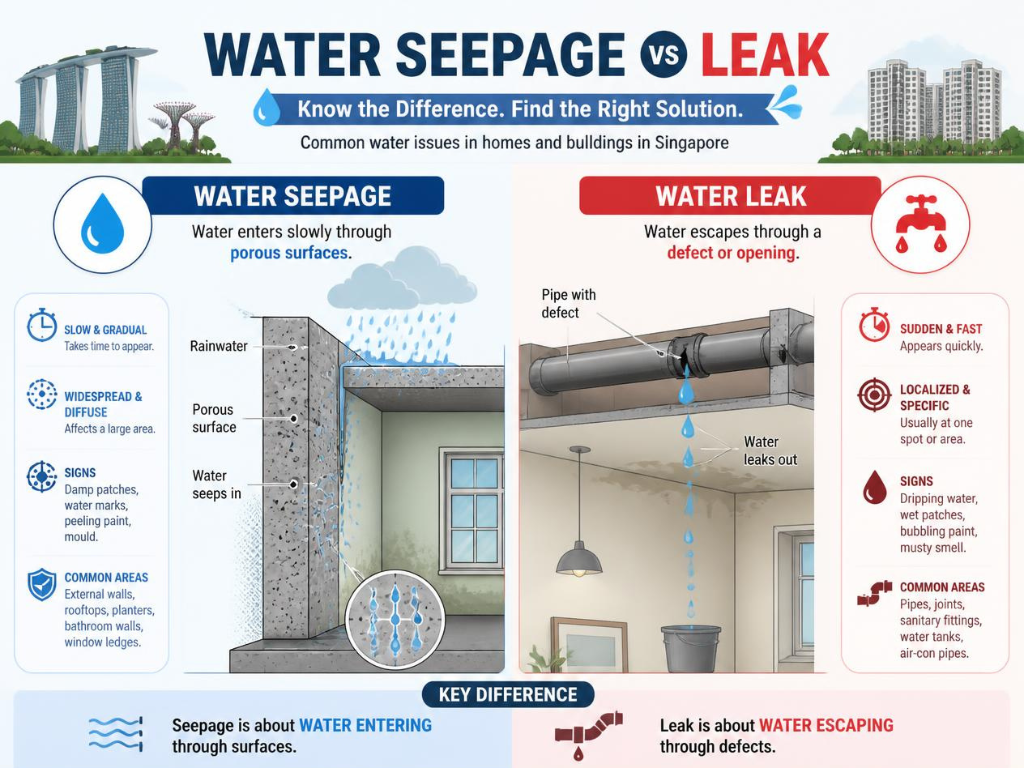

Telling water seepage from a water leak decides who pays, not just what gets repaired. A pipe leak inside your flat is your bill; seepage through a floor slab brings HDB cost-sharing or, in a condominium, a statutory presumption against the unit above. This blog walks you through the tests that separate them before you commit to any plumbing repair work.
What is the difference between water seepage and a water leak?
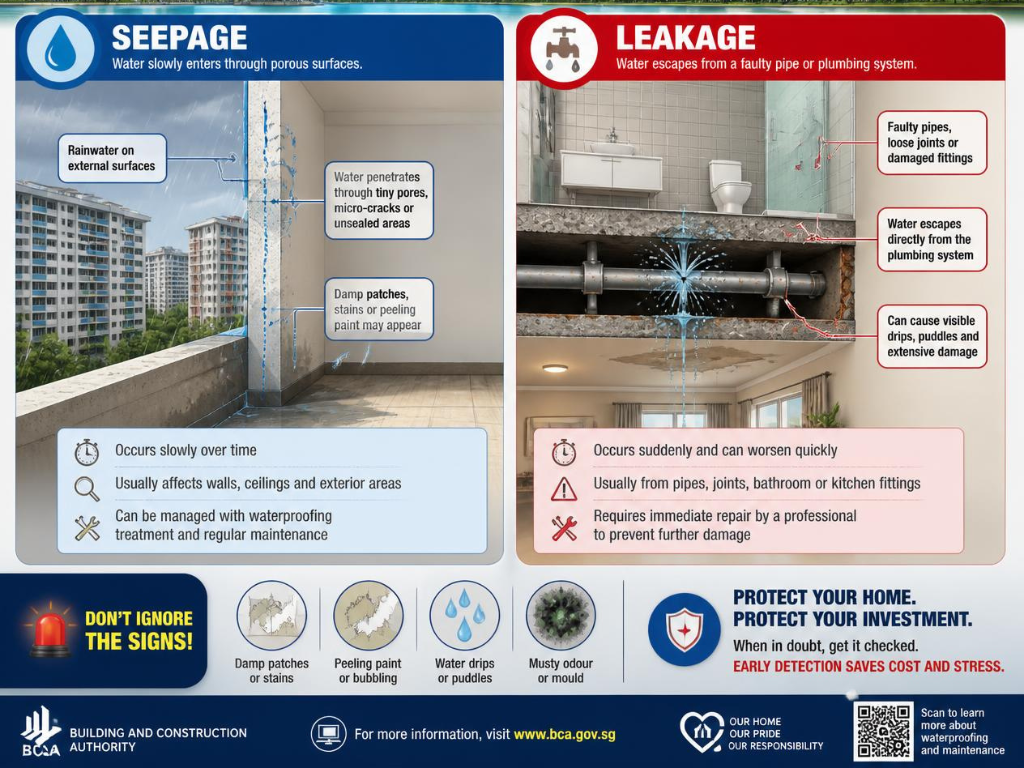
A leak is water escaping from a pipe under pressure. Seepage is water migrating slowly through building fabric, moving through concrete, screed or masonry because a waterproofing layer has failed. Condensation is a third case entirely, where humid air deposits moisture on a cool surface with no water source behind the wall at all.
The mechanisms produce different evidence. A pressurised pipe leak delivers a consistent volume regardless of weather, gets worse when the affected fitting is used, and continues at 3am when nobody is home. Seepage tracks the wet area next to it, so it worsens after showers and after rain on an external wall, and it eases during a dry spell.
Speed separates them too. A leak on a supply pipe under mains pressure produces visible damage in days. Seepage develops over months, which is why households usually notice the discolouration before they notice any water.
Getting this right first is the whole job. A plumber replacing pipework will not stop seepage through a slab, and a waterproofing contractor hacking a bathroom floor will not stop a leaking concealed pipe. Committing to the wrong trade is the most expensive mistake available in this category.
How do you test whether it is a pipe leak?
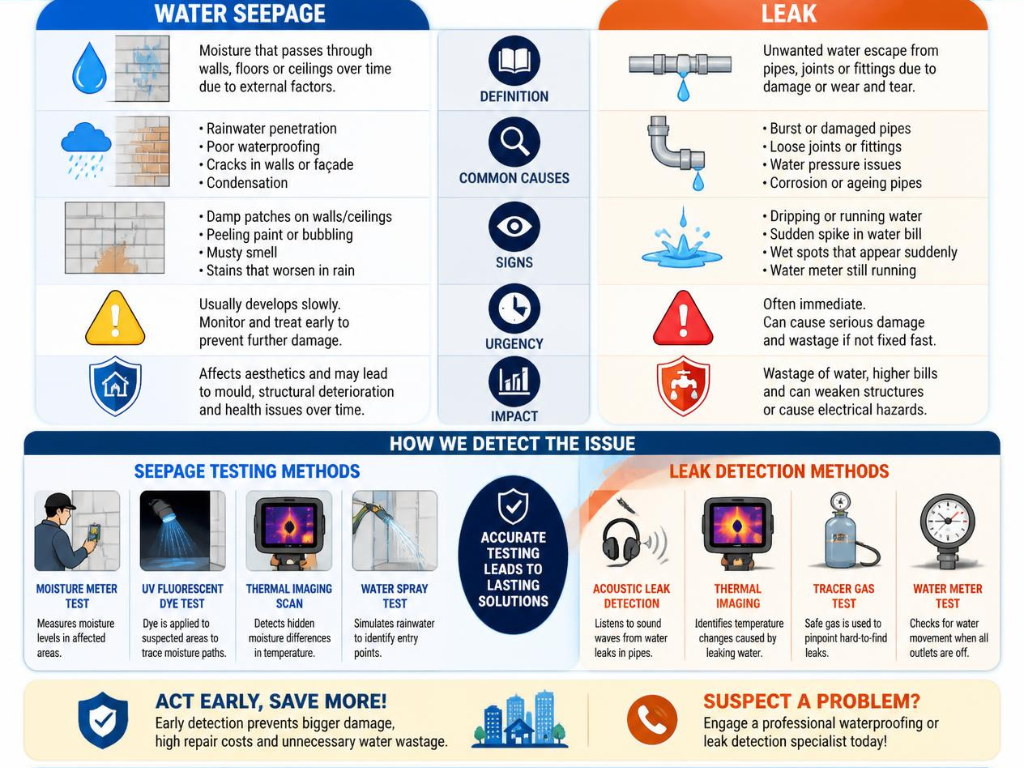
Use the water meter. Close every tap and appliance in the flat, note the meter reading, wait 30 minutes without using water, then read it again. Movement means water is escaping from your pipework. No movement means the damp patch is not a pressurised leak.
PUB publishes this as its own method for spotting silent leaks, which it puts at more than 10 litres of wastage an hour. A smart water meter gives the same answer faster, since the hourly consumption view will show a steady overnight baseline where a household with no leak reads zero.
Run the test properly or not at all. A running toilet cistern, an ice maker, or a water heater refilling will all move the meter and produce a false positive, so those need isolating first. Close the isolation valve to each suspect fitting and repeat if the first result is ambiguous.
The result is binary and it saves money immediately. A moving meter justifies concealed leak detection and a plumber. A still meter rules out the plumbing entirely and points you at waterproofing, which is a different contractor and a different budget.
What does efflorescence tell you?
White crystalline deposits on a wall confirm seepage rather than a leak. Efflorescence is salt left behind when water travels through concrete or masonry and evaporates at the surface, carrying dissolved minerals out of the material with it.
That mechanism is the point. Water has to pass through the building fabric to produce it, which a pipe leak spraying onto a surface does not do. Finding a chalky white bloom on a wall or ceiling means water has been moving through the structure for a sustained period.
Do not simply wipe it away. Efflorescence returns for as long as water keeps migrating, so scrubbing and repainting treats the symptom and hides the diagnosis. Households that repaint repeatedly over the same patch are usually two years into an undiagnosed waterproofing failure.
Paint behaviour adds a second marker. Bubbling and peeling across a broad area indicates moisture pushing outward from within the wall, while a leak tends to produce a defined wet patch that spreads from a point.
Could it just be condensation?
Condensation is common in Singapore and it is the most over-diagnosed and under-diagnosed damp cause at once. Humid air meeting a cool surface deposits moisture on the outside of that surface, with no water source behind it.
The towel test settles it. Dry the area completely, tape a square of plastic sheet tightly over the patch, and leave it 24 hours. Moisture on the room side of the plastic is condensation. Moisture trapped underneath, against the wall, means water is coming through the structure.
Location gives it away too. Condensation concentrates on surfaces that run cool, so chilled water pipes, air-conditioned wall cavities and the outside of cisterns are the usual sites, and it appears and dries on a daily cycle rather than persisting.
Ventilation resolves the condensation version at no plumbing cost. An extractor fan running during and after showers reduces the humidity load enough to stop surfaces sweating, which is why the diagnosis is worth confirming before anyone quotes for waterproofing.
Why is seepage so common in older HDB flats?
Because the waterproofing membrane is a consumable with a service life. HDB attributes ceiling leaks to the waterproof membrane and screed deteriorating through natural wear and tear, and identifies them as particularly common in older flats, concentrated in bathrooms and toilets.
Singapore bathrooms are built in layers: structural slab, waterproofing membrane, screed, then tiles. Water passing a cracked tile joint reaches the membrane, and once the membrane has degraded, that water enters the screed and travels laterally before finding a path through the slab to the ceiling below.
Lateral travel is why the damp patch rarely sits under the source. Water entering at a shower area can emerge through a ceiling two metres away, which is exactly why hacking directly beneath the stain is so often wasted work.
Repair means reaching the membrane. HDB names re-screeding as the most effective solution, which involves removing tiles to replace the membrane and screed beneath, with alternative methods available depending on severity and location.
Who pays for seepage between two flats?
The answer differs sharply between HDB and private strata, and the diagnosis you just made decides which framework applies. This is the practical reason the seepage-versus-leak question matters beyond curiosity.
In HDB flats, slab seepage from wear and tear is treated as a shared responsibility between the upper and lower flat owners, who agree repair arrangements and split the cost. The Goodwill Repair Assistance scheme softens that further, with HDB co-paying 50 per cent and the two owners covering 25 per cent each. A leak from a fitting inside your own flat sits outside that entirely and is yours alone.
Condominiums run on a different rule. Under section 101(8) of the Building Maintenance and Strata Management Act 2004, where water leaks through the ceiling of a lower unit, the leak is presumed to originate from the lot immediately above, and the upper owner is treated as responsible unless they can show the cause lies elsewhere. The burden of proof sits upstairs, not with the affected owner.
That presumption is a starting position rather than a verdict. An upper owner who demonstrates the water came from a common pipe or the facade shifts responsibility to the management corporation, which is precisely why an independent diagnosis is worth more than an argument. Disputes that cannot be settled between owners go to the Strata Titles Board.
Is external wall seepage different from internal seepage?
External wall seepage tracks the weather, which internal seepage does not. Damp appearing on a wall that faces outside, worsening during monsoon periods and easing in dry weeks, points at the building envelope rather than at anything in your flat.
Responsibility moves with it. External walls in HDB blocks are common property maintained by the Town Council, and in condominiums the facade falls to the management corporation, so external wall seepage is generally not a cost the individual owner carries.
Distinguishing it takes patience rather than equipment. Log the patch weekly against rainfall for a month, since correlation with heavy rain is close to conclusive, and a photograph with a date beats a recollection when you report it.
Internal seepage behaves independently of weather and follows household water use instead, worsening after showers or laundry regardless of what is happening outside.
Does a damp meter give you the answer?
A damp meter tells you where the moisture is, not what caused it, and treating a reading as a diagnosis is the most common mistake in this category. Pin meters read surface conductivity and non-invasive meters read a shallow depth, so both are mapping instruments rather than diagnostic ones.
They are genuinely useful for mapping extent. Sweeping a wall to find where readings peak identifies the wettest point, which narrows where any investigation should begin and prevents opening the wrong section of wall.
Salts distort readings, which matters here specifically. Efflorescence deposits are conductive, so a pin meter reads high on a salt-contaminated surface that has since dried, producing a false positive exactly where seepage has previously occurred.
Combine the meter with the meter test, so to speak. Mapping plus a still water meter points hard at seepage; mapping plus a moving water meter points at a pipe, and that pairing beats either instrument alone.
What does each repair actually cost?
Cost tracks the diagnosis rather than the symptom, and the gap between the two answers runs into four figures. A pipe repair is a contained plumbing job; a waterproofing repair is minor renovation involving hacking, membrane, screed and retiling.
Plumbing sits at the lower end. Fix It Papa’s rates start at $50 for tap and faucet work, with concealed pipe repair priced by access difficulty, and our 2026 plumbing rate guide puts after-hours attendance at $50 to $150 on top.
Waterproofing is a different category. Re-screeding a bathroom means removing finishes and reinstating them, so the tiling and reinstatement often exceed the waterproofing itself, and the works involve the flat below when the slab is affected.
Diagnosis first is the cheapest money in the sequence. Committing to a re-screed when the actual fault is a leaking concealed pipe means paying for a renovation and still owning the leak, and the reverse mistake wastes a plumber’s call-out.
When should you call a plumber rather than a waterproofing contractor?
Call a plumber when the water meter moves with everything closed. Call a waterproofing specialist when it does not and the damp correlates with a wet area above or beside it. That single result routes the job correctly more reliably than any visual assessment.
Escalate on speed. Water appearing rapidly, spreading within hours, or accompanied by a pressure drop indicates a pressurised failure rather than seepage, and an emergency plumber call-out is the right response. Seepage never needs a same-day response.
Fixture leaks deserve ruling out before anything structural. Water at a toilet base, under a basin or around a shower tray is a fitting problem, and confirming the toilet or cistern seal takes minutes against days for a waterproofing investigation.
Scope determines who is legally permitted to do the work. Repairing a water supply pipe is regulated work requiring a PUB Licensed Plumber, while clearing a floor trap or replacing a tap is not, a division set out in the HDB rules on plumbing works.
Conclusion
One damp patch has three possible mechanisms and the water meter separates the first from the other two in half an hour. A moving meter means a pipe and a plumber. A still meter with efflorescence or weather correlation means the building fabric, a waterproofing contractor, and a cost split governed by HDB rules or the section 101(8) presumption. The physical diagnosis decides the financial one.
Run the meter test tonight with every tap closed. Book a diagnostic visit with your reading and a photo of the patch, so the right trade is assigned before anyone hacks a wall.
Frequently asked questions
How do I know if water is seeping or leaking?
Close every tap and appliance, read the water meter, wait 30 minutes and read it again. Movement confirms a pressurised pipe leak. No movement points to seepage or condensation. PUB publishes this as its method for detecting silent leaks, which waste more than 10 litres an hour.
What causes water seepage in HDB walls?
Deterioration of the waterproofing membrane and screed through natural wear and tear, which HDB identifies as particularly common in older flats and concentrated in bathrooms and toilets. Water passing a cracked tile joint reaches the degraded membrane, enters the screed, then travels laterally before emerging elsewhere.
Who is responsible for seepage from the unit above in a condo?
The upper unit, by default. Section 101(8) of the Building Maintenance and Strata Management Act 2004 presumes an inter-floor leak originates from the lot immediately above, and the burden falls on that owner to prove otherwise. Unresolved disputes go to the Strata Titles Board.
Is white powder on my wall a sign of a leak?
It signals seepage rather than a pipe leak. Efflorescence is salt deposited when water travels through concrete or masonry and evaporates at the surface, so it requires water moving through the structure. Repainting over it hides the diagnosis while the underlying waterproofing failure continues.
Can a damp meter tell me where the leak is?
No. A damp meter maps where moisture sits, not what caused it, and efflorescence salts produce false high readings on surfaces that have since dried. Use it to find the wettest point, then confirm the cause with the water meter test before engaging any contractor.
Leave a Reply
You must be logged in to post a comment.