
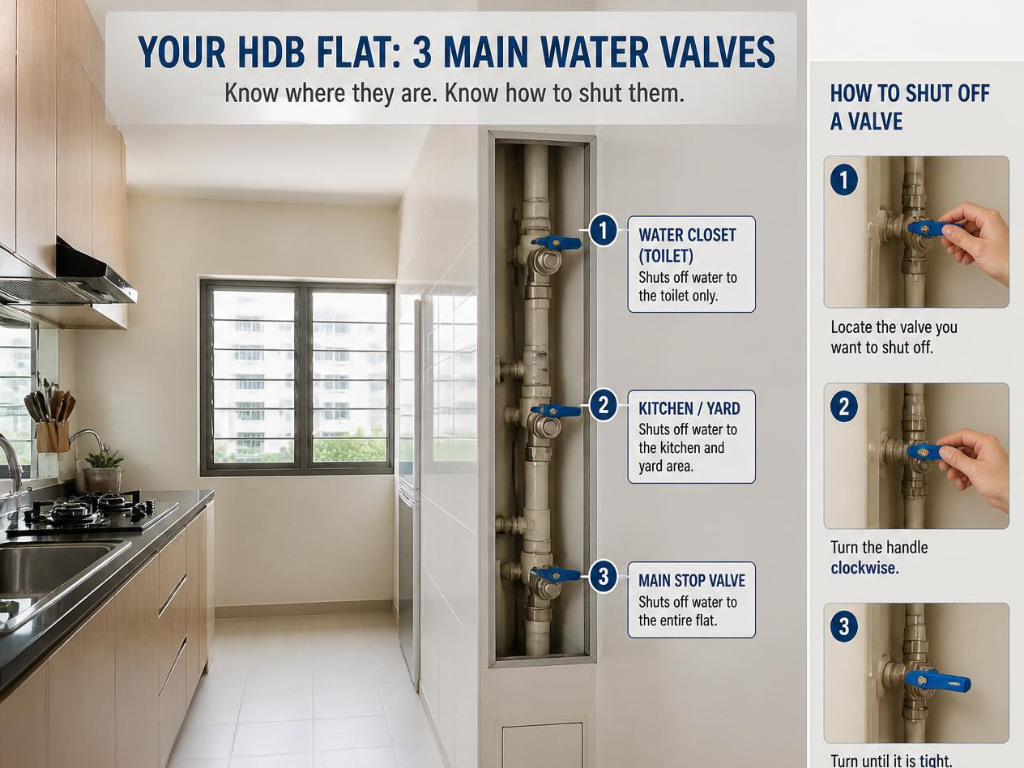

Knowing how to turn off the water supply in an HDB flat takes two minutes to learn and saves hours when something fails. Turning a valve is not regulated plumbing work under PUB rules, so no licence and no plumber is involved. This blog walks you through all three shut-off levels, which way each turns, and the one appliance to switch off first, before any home plumbing work starts.
Where is the main water shut-off valve in an HDB flat?
Outside your front door, at or beside the water meter. In most HDB blocks the meter sits in the common corridor near the entrance or in a riser cupboard on your floor, and the stop valve is the tap or spindle immediately next to it.
Three levels of control exist, and knowing which one you need saves cutting water to the whole flat for a job that affects one tap. Fixture isolation valves sit under the kitchen sink, under the washbasin, beside the toilet cistern and on the water heater inlet. The flat’s main stop valve at the meter cuts everything in the unit. The riser valve serves the whole stack and belongs to the Town Council, so residents do not touch it.
Meter clusters cause the most trouble. Older blocks group several units’ meters together, often unlabelled, so confirm which spindle is yours before turning anything. Turning the wrong one cuts your neighbour’s water while yours keeps running.
Label yours once you have found it. A strip of tape and a marker on the meter housing costs nothing and outperforms trying to remember at 3am. Do it now rather than during the emergency, since the households that handle a leak cheaply are the ones who located this valve months earlier.
Which way do you turn the valve to shut off the water?
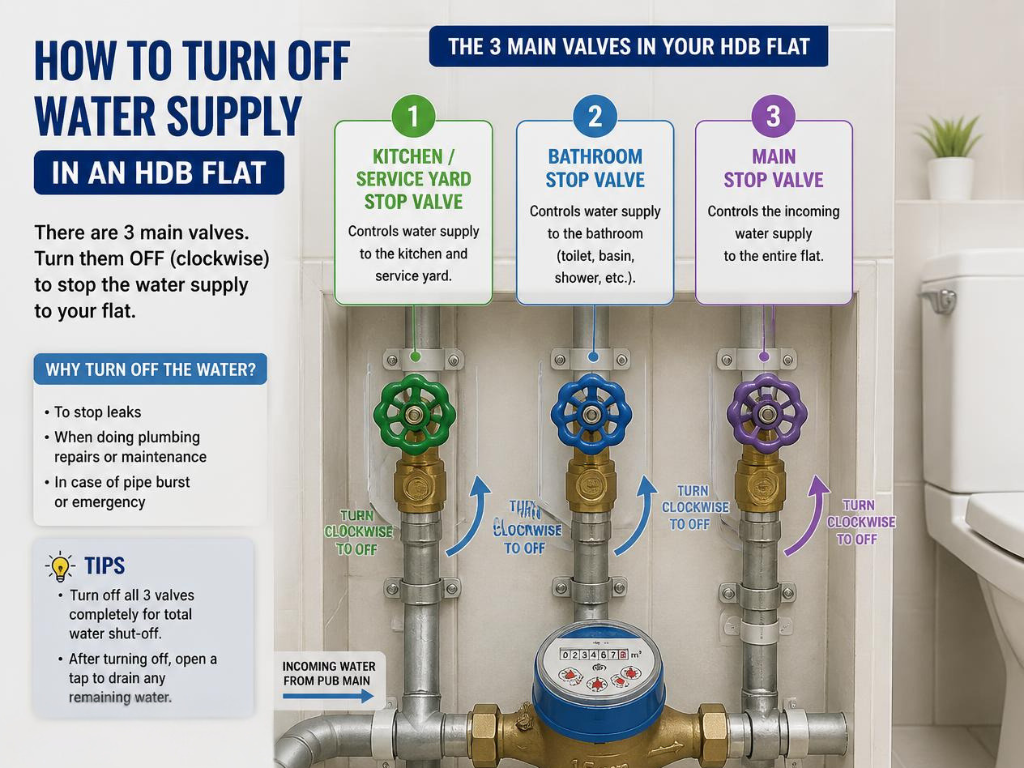
Clockwise to close, anticlockwise to open, on every screw-type valve in a Singapore flat. The old plumbing mnemonic is righty-tighty, and it holds for stop valves, gate valves and the screw-down isolation valves under most sinks.
Quarter-turn valves work differently and are easier to read. A lever sitting parallel to the pipe means open; turn it 90 degrees so it sits across the pipe and the water is off. There is no ambiguity and no need to count turns.
Do not force a valve that resists. Screw-down valves have a defined stop, and continuing to crank past it strips the spindle or splits the washer inside, converting a working valve into a repair job. Firm hand pressure is the limit.
Turn it fully. A stop valve left half-closed restricts flow to the whole flat without stopping it, and a partly closed main valve is one of the more common causes of unexplained weak pressure after a repair.
How do you turn off the water under the kitchen sink?
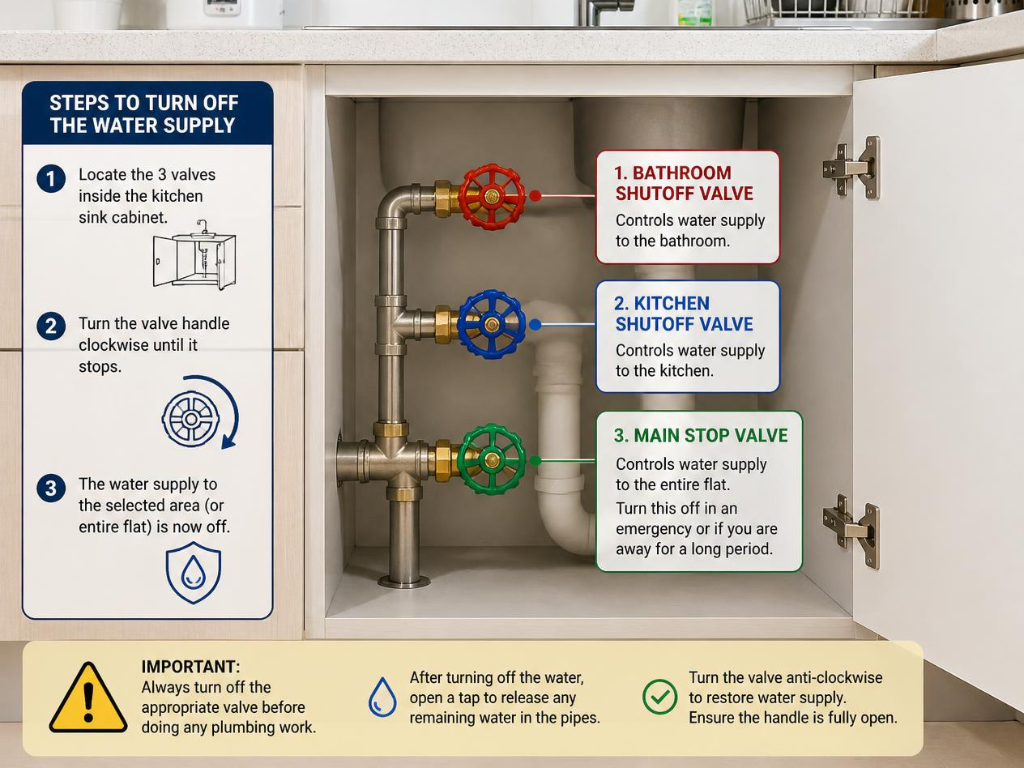
Look at the flexible hoses feeding the tap and follow them down to the small valves where they meet the wall or the pipe stub. Those are the isolation valves, and closing them stops water to that tap alone.
Most kitchen installations have two, one for cold and one for hot where a heater feeds the sink. A mixer tap fed by a single supply has one. They sit low in the cabinet, often behind stored items, and a torch saves several minutes of feeling around.
Some older HDB kitchens have no isolation valve at all. Where the flexible hose runs straight to the pipe with nothing between, the flat’s main stop valve is the only option for that fitting, and adding an isolation valve during the next tap replacement is worth the small cost.
Test the isolation, do not assume it. Close the valve, then open the tap and wait. Water that slows to a trickle rather than stopping means the valve is passing, and working on a tap fed by a leaking isolation valve is how a routine job turns wet.
How do you turn off the water to just the toilet?
Trace the flexible hose from the bottom of the cistern down to a small valve on the wall or floor. That angle valve controls the cistern alone, and closing it lets you work on the toilet while the rest of the flat keeps running water.
Flush after closing it. The cistern empties and does not refill, which confirms the valve has sealed and leaves the tank empty for whatever work follows. A cistern that refills after a flush means the valve is passing and needs replacing before anything else proceeds.
Angle valves seize more than any other valve in a flat, because they sit untouched for years in a humid bathroom. A valve that will not turn by hand should not be forced with a spanner, since the risk is snapping the spindle and turning a cistern repair into a supply pipe repair.
Cistern work itself stays within handyman scope. PUB permits replacing a flushing mechanism without a licence, so a toilet cistern repair is a job you can hire cheaply once the angle valve is closed.
Should you switch off the water heater before shutting the supply?
Yes, and this is the step households skip. A storage water heater left powered while the supply is closed can run its element in a tank that is draining, and an element that heats without water around it burns out in minutes.
The order matters. Switch the heater off at its isolator switch first, then close the water supply. Reverse that on the way back: restore the water, let the tank fill completely, then switch the power back on. Filling is confirmed by opening a hot tap and waiting for a steady stream rather than spitting air.
Instant heaters are less exposed but follow the same rule. They heat only when flow is detected, so a closed supply generally means no heating, though switching off at the isolator removes the risk entirely and costs nothing.
Skipping this is an expensive mistake for the size of the shortcut. A burnt-out element means a repair visit and a replacement part, so factor it in before any water heater servicing or supply work.
What if the main stop valve is stuck or won’t turn?
A valve that has not moved since handover often seizes, and forcing it splits the spindle. Work it gently rather than hard: apply steady pressure in the closing direction, back off, and repeat, which frees most valves that have simply stiffened with scale.
Penetrating oil helps on an external spindle and should stay off anything that touches drinking water internally. A cloth for grip beats a spanner, since a spanner concentrates force on a corroded spindle and snaps it.
A seized valve during an active leak is functionally no valve at all, which is the argument for testing yours annually rather than discovering the problem under pressure. Turn it fully off and back on once a year and it will keep working.
Where it genuinely will not move, stop. Replacing a stop valve on the supply is regulated work requiring a PUB Licensed Plumber, unlike operating one, and the boundary is set out in the HDB rules on plumbing works.
What if the tap outside your flat has no handle?
Newer HDB blocks fit headless valves, a bare spindle with no permanent handle, so that residents and passers-by cannot casually shut off a unit. Older estates use a square-shaft tap that turns with a standard tap key.
Buy the key before you need it. A tap key is roughly a $10 item at any hardware shop, and keeping one in the same drawer as your torch converts a locked-out emergency into a thirty-second job.
Without the key, your fallback is the fixture-level isolation valves inside the flat. Those cover most situations, since the majority of household leaks originate at a tap, a cistern or a flexible hose rather than in the concealed pipework.
Newly handed-over BTO flats follow the same pattern, with the meter and valve in the corridor. Locate it during the defects inspection while someone from the contractor is present to point it out, rather than working it out alone later.
Should you shut off the water before going on holiday?
Close the main stop valve for any absence longer than a few days. A flexible hose failing behind a washing machine while nobody is home is the single most expensive scenario in household plumbing, and it costs nothing to eliminate.
Switch the storage water heater off at the same time. Heating a tank for an empty flat wastes electricity at 34.78 cents per kWh including GST, the rate set from 1 July 2026, and removes any dry-firing risk while the supply is closed.
Check the meter before you leave. Close every tap, note the reading, and compare it on your return; PUB publishes the same check as its method for spotting silent leaks, which it puts at more than 10 litres of wastage an hour. Where your premises has one, the hourly view in PUB’s smart water meter portal sends alerts for suspected leaks and abnormal consumption.
Leave one tap slightly open after closing the main. This releases residual pressure in the pipework so nothing sits pressurised against a weak joint for a fortnight.
How do you turn the water back on safely?
Open the valve slowly, roughly one full turn at a time. Restoring full pressure instantly sends a surge through pipework that has just been sitting empty, and surges fatigue joints and dislodge scale.
Expect air and discolouration. Air trapped during the shut-off leaves taps spitting for a minute or two, and sediment disturbed in the pipes can tint the water briefly. Run the taps until both clear, starting with the one furthest from the meter.
Check for leaks before walking away. Water that has been standing against a valve or a joint sometimes seeps once pressure returns, and the five minutes spent looking under sinks is the cheapest inspection available. Where a stain or damp patch appears afterwards, concealed leak detection is the correct next step rather than waiting.
Power the water heater last. Confirm the tank is full by drawing a steady stream from a hot tap, then switch the isolator back on.
Do you need a plumber to shut off your water?
No. Operating an existing valve is not regulated plumbing work, so no licence applies and nothing stops you doing it yourself at any hour.
The line sits at altering the installation rather than using it. PUB’s schedule of simple plumbing works lets anyone without a licence replace taps and mixers, flexible hoses, shower hoses and flushing mechanisms, while replacing a stop valve or altering the supply pipe is regulated work needing a PUB Licensed Plumber. Engaging an unlicensed plumber for regulated works has been an offence since 1 April 2018.
That split explains what a call-out is actually for. A plumber attending a leak is not being paid to close your valve; they are being paid for the repair afterwards, which is why closing it yourself before they arrive reduces the damage they have to work around.
Where water is actively escaping and you cannot stop it, an emergency plumber call-out is the right call, and Fix It Papa’s rates start at $50 for tap and faucet work with an after-hours surcharge on top.
Conclusion
Three valves control water in an HDB flat and most households have only ever used one. Isolation valves handle most jobs without cutting the flat off, the main stop valve at the meter stops everything, and the riser belongs to the Town Council. Switch the storage heater off before closing anything and back on only after the tank refills, since a dry element fails in minutes.
Find your main stop valve this week, turn it off and on to confirm it moves, then label it. Book a plumbing visit and ask the technician to confirm your valve locations on site.
Frequently asked questions
Where is the water stopcock in an HDB flat?
Outside the unit at the water meter, usually in the common corridor near your entrance door or in a riser cupboard on your floor. Older blocks group several meters together without labels, so confirm which spindle is yours before turning it. Inside the flat, isolation valves sit under sinks and beside the toilet.
Which way do I turn the valve to shut off the water?
Clockwise to close on screw-type valves. Quarter-turn lever valves close when the lever sits across the pipe rather than parallel to it. Do not force a valve past its stop, since that strips the spindle and turns a working valve into a repair requiring a PUB Licensed Plumber.
Can I turn off the water supply valve outside my flat?
Yes, provided it is your own unit’s valve. Operating an existing valve is not regulated plumbing work under PUB rules, so no licence is needed. The riser valve serving the whole stack is different: that is Town Council equipment and residents should not operate it.
Do I need to turn off the water heater when I shut off the water?
Yes, switch a storage heater off at its isolator first. An element that heats in a draining tank burns out within minutes. On restoring supply, fill the tank fully and confirm a steady stream from a hot tap before switching the power back on.
Why is my water pressure weak after turning the supply back on?
The main stop valve is partly closed, or air is trapped in the pipework. Open the valve fully, then run taps starting with the one furthest from the meter until the flow steadies and clears. Trapped air causes spitting taps for a minute or two after any shut-off.
Leave a Reply
You must be logged in to post a comment.